RLMs Revolutionize Long-Context Tasks, Outperforming Traditional AI Approaches with Up to 45.4% Accuracy Gains
September 9, 2026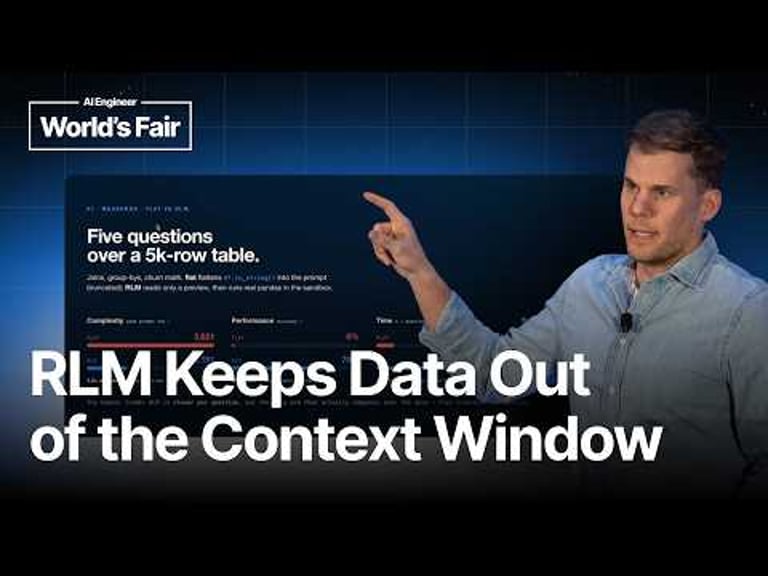

Anthropic Workflows and other implementations are embracing RLM-like techniques, positioning RLMs as production-ready alternatives to coding agents for large or dense inputs, while reducing cost and context bloat.
RLMs interact with a symbolic REPL and delegate to sub-models, outperforming RAG and agent-based approaches on long-context tasks with accuracy improvements ranging from 2.6% to 45.4% in benchmarks and real-world applications in security scanning and data analysis.
A worked example shows a cohort retention analysis on data frames using about 20 lines of code within a Compound platform, featuring transparent reasoning and a clear split between generated code and final output.
The architecture combines a deterministic outer shell with a model-defined interior, where engineers set the maximum iterations and the model decides execution steps within that bound.
Looking ahead, post-training RLM-awareness could speed adoption, with expectations of rapid advances and higher levels of abstraction in practice.
RLMs are best suited for large or dense inputs, substantial output generation, decomposable tasks, and long-horizon sessions; they are less ideal when content fits easily in context, latency is critical, or the base model is a weak coder.
The RLM ecosystem spans DSPy, RLM-focused frameworks, and real-world deployments such as Trampoline AI, AWS Log Insights, Halo, and an OWASP demo, illustrating scalability across large codebases.
Compared with coding agents like Claude Code, RLMs are generally less bloated and more efficient, though the comparison may be imperfect and further data is needed.
There is a trajectory toward model-native recursion and context management, with labs adopting RLM-like patterns and the era of hand-built chunking and retrieval pipelines potentially ending.
An RLM is defined by three architectural distinctions: symbolic REPL interaction with first-class data objects, recursive delegation to sub-LMs within the REPL, and a model-defined execution strategy that keeps the main context window relatively small.
Key quotes emphasize context as a symbolic object, growing model autonomy, and the risk of context rot when the context window becomes saturated.
RLMs outperform prompting and tool-calling by avoiding context rot, with benchmarks like LOONG and BrowseComp showing superior performance and cost-efficiency, including notable long-context accuracy gains especially on code-friendly tasks.
Summary based on 1 source