Skild AI Launches S1 Robot Model: Revolutionizing Task Learning with Single-Video Adaptability
September 10, 2026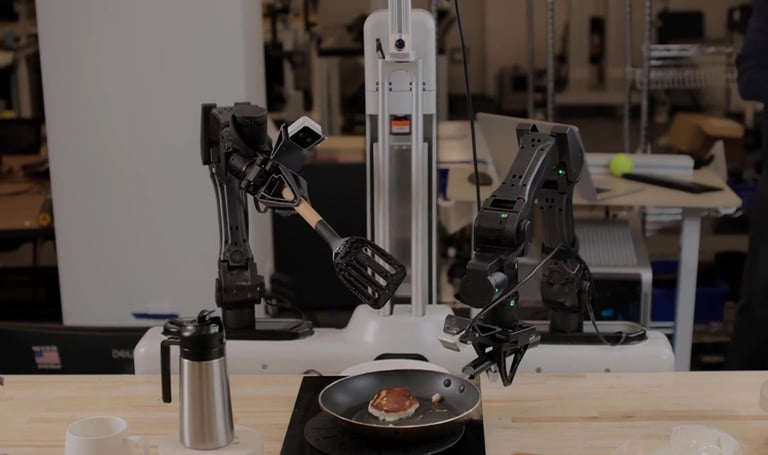

In a landmark collaboration, Skild AI demonstrates how its S1 robotic foundation model, built on NVIDIA AI infrastructure, reached a $100 million annual revenue run rate within 10 months of its first commercial deployment.
Commercial traction is solid, with more than 60 deployment partnerships across manufacturing, logistics, inspection, security, and food prep, including high-precision assembly on Foxconn lines where Skild Brain coordinates dual-arm manipulators for tasks like busbar installation and screw fastening with disturbance recovery.
NVIDIA technologies underpin the pipeline, using Omniverse and Isaac Sim for simulation, Cosmos for diverse data, Isaac Lab for reinforcement learning, and Newton-based physics to model contact and manipulation.
The piece advises practitioners to lean into in-context learning when data collection is costly or time-consuming, but to pause if data collection is already robust or internal benchmarks haven’t been met.
Context is provided by comparing Skild to Generalist AI’s GEN-1.5, highlighting differences in how in-context learning arises and current limitations in claims.
Skild argues rapid learning is essential as robots move from controlled environments to dynamic real-world settings where continuous data collection is impractical.
Cautions are raised that the reported numbers are Skild’s internal tests and not third-party validated, and some valuation figures from media may lack official corroboration.
The company warns that demonstrations can be misleading; rapid initial performance does not guarantee reliable, scalable deployment, emphasizing practical throughput and deployment readiness.
Skild claims teaching S1 a new task takes minutes, versus hours of teleoperation and task-specific fine-tuning in traditional workflows.
A deployment data flywheel is envisioned: insights from real deployments feed improvements to the general-purpose foundation model, reducing the need for task-specific specialization over time.
Experiments show data volume matters: with 1,000 hours of training data, language prompts outperform image-context prompts (53% vs 43%), while with 100,000 hours, in-context prompts reach 66% success on unseen tasks and 9% on a different metric.
The process starts with an operator recording a task video; S1 infers intent, objects, and action sequences to map to robot actions without retraining or task-specific fine-tuning.
Summary based on 12 sources
Get a daily email with more Tech stories
Sources
NVIDIA Blog • Sep 10, 2026
Skild AI Taps NVIDIA Physical AI to Teach Robots New Tasks From a Single Video
Crypto Briefing • Sep 10, 2026
Skild AI reaches $100M revenue run rate within 10 months of first commercial deployment
Quantum Zeitgeist • Sep 11, 2026
Skild AI Robot Learns New Factory Tasks From A Single Video
Blockchain.News • Sep 11, 2026
Skild AI's S1 Uses NVIDIA Tech to Teach Robots via Video