Oracle Unveils Scalable Multi-Agent Ecosystem with Groundbreaking Performance on 1,000-Agent Kubernetes Cluster
September 18, 2026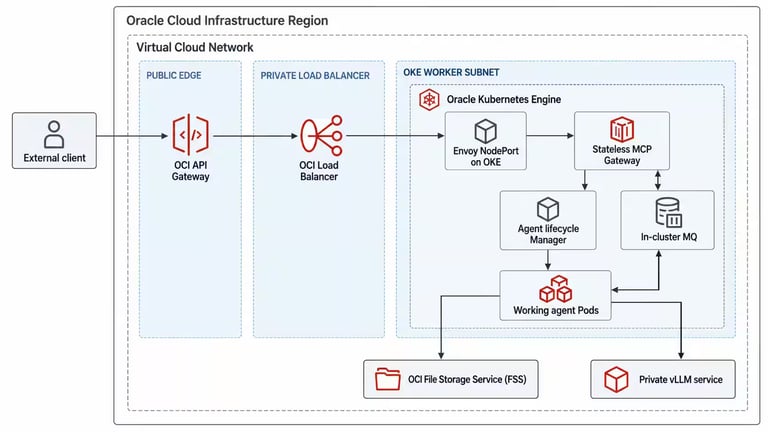

The project outlines OCI as the foundation for a full multi-agent ecosystem, with ongoing work to validate FSS vs Lustre, implement database-backed state, managed messaging, vector capabilities, graph orchestration, and private model serving for larger agent populations.
Performance results show the fastest full batch at 500 concurrent requests delivering 18.4 successful requests per second with a p99 latency of 48.9 seconds; at 50–100 concurrent requests, p99 latency hovered around 10 seconds; and with 1,000 concurrent requests the batch finished with a p99 latency of 111.5 seconds.
System design emphasizes collaboration, evidence exchange, and controlled workflows as more effective than simply increasing the number of agents, with planning benchmarks set at population milestones of 100 and 1,000.
Deployment evidence shows a 12-instance OCI cluster and a 10-node pool hosting agent pods, running Kubernetes version 1.36.1.
Workspace design combines private agent state with shared project artifacts; FSS provides durable, POSIX-compliant file access with scoped mounts to balance isolation and collaboration.
Architecture centers on Oracle Kubernetes Engine for working-agent pods, FSS for durable shared workspaces, a stateless Model Context Protocol Gateway, and an in-cluster message queue, with agents privately executing model interactions.
Scope and sources describe the JAPAC CoE AI-First initiative, detailing Oracle services used, including OKE, FSS, Lustre, API Gateway, Load Balancer, VCN, OCIR, Queue, multiple databases, vector DB, Property Graph, Generative AI features, private endpoints, and Compute.
A public end-to-end Ashburn run with 1,000 persistent agents completed 6,000 requests without client retries, demonstrating a viable OCI-based foundation for large-scale agent operations.
The piece introduces a 1,000-agent baseline on Oracle Kubernetes Engine (OKE) with OCI File Storage Service (FSS) to illustrate scalable agent collaboration on a persistent cluster.
Future evaluation areas include HA state testing via databases, asynchronous delivery through OCI Queue, shared context with vector search, dynamic graph orchestration using Oracle Property Graph, and private model serving options such as self-managed vLLM, private endpoints, or Generative AI private models.
Summary based on 1 source
Get a daily email with more AI stories
Source
cloud-infrastructure • Sep 17, 2026
Scaling 1,000 AI Agents on Oracle Cloud Infrastructure Kubernetes Engine and File Storage