AI Revolutionizes Astronomy: Chinese Project Combines AI Agents and Telescopes for Autonomous Observations
September 19, 2026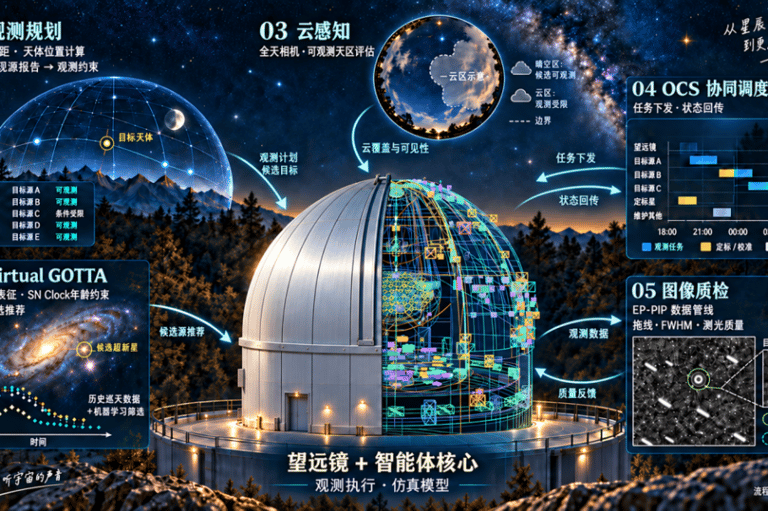

A national project led by the National Astronomical Observatories of the Chinese Academy of Sciences is exploring the integration of large AI models and agents with telescope control to plan tasks and carry out observations based on researcher goals, equipment status, and observing conditions.
This effort marks a shift from AI as a data-analysis tool toward autonomous operation of scientific instruments and research processes.
AI agents are capable of state perception, task planning, plan generation, and workflow validation, enabling a closed-loop, autonomous observation process.
Experts identify four bottlenecks for broader adoption: evaluation speed, the gap between simulation and reality, auditability and responsibility, and the need to explore beyond predefined objectives, along with interface, data quality, maintenance, and ethics concerns.
The workflow starts with inputting environmental and equipment data, then creating an observation plan tested in a simulation before real-world execution, with a human in the loop for final confirmation.
The approach prioritizes maximizing observing time by planning based on target priority, real-time telescope status, and visibility windows, followed by execution and evaluation of results.
Researchers are developing models to decide what and how to observe, including a cross-survey time-series model to identify very early supernova candidates and a short-term local weather model to optimize plans.
The system connects multiple interfaces and tools to monitor status, prioritize targets, schedule observations, and manage data return paths, enabling rapid iteration and early signaling of potential events like supernova candidates.
Agents have already flagged eight early supernova candidates, with two followed-up observations when weather allowed.
Key results include eight early supernova signals detected by the agent, two follow-up observations under favorable weather, and a development model that compresses months of work into days at a cost around a thousand yuan.
The Sitian Pathfinder sky-survey test bed and its full prototype system have integrated these capabilities, achieving eight very early supernova alerts and two follow-up observations enabled by good weather.
The projected trajectory foresees initial impact in fields with mature toolchains, with semi-automated loops in the next five years where humans define goals and evaluators filter results while agents execute and iterate.
Summary based on 8 sources
Get a daily email with more AI stories
Sources

Tribune • Sep 19, 2026
China's StarWhisper Telescope earns place in Stanford AI Index Report
CGTN • Sep 19, 2026
China's StarWhisper telescope earns place in Stanford AI Index
chinadaily.com.cn • Sep 19, 2026
China's AI-powered StarWhisper Telescope gains global recognition