AI Revolutionizes Astronomy: Chinese Project Combines AI Agents and Telescopes for Autonomous Observations
September 19, 2026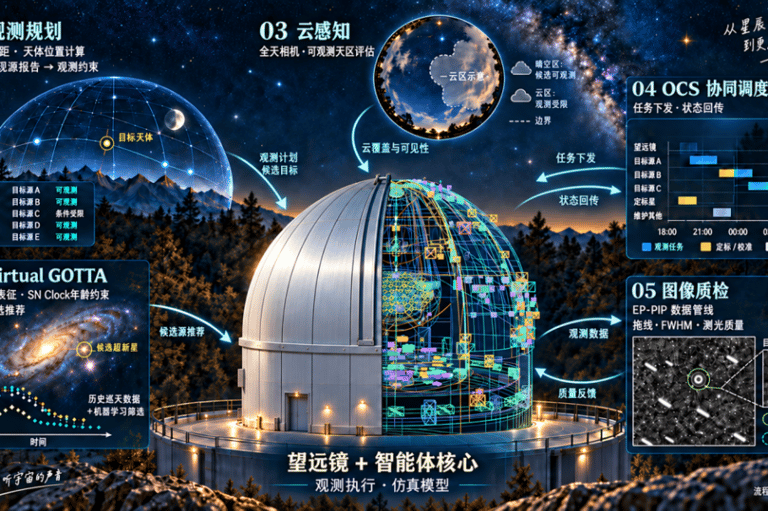

A Chinese project led by the National Astronomical Observatories aims to merge large AI models and agents with telescope control to plan tasks and conduct observations based on researcher goals, equipment status, and observing conditions.
This effort marks a broader shift of AI from data analysis toward autonomous operation of scientific instruments and research processes.
The StarWhisper Telescope is highlighted in the Stanford AI Index Report 2026 as a leading example of applying AI agents to physics, astronomy, chemistry and materials science for 2025.
The workflow starts with inputting environmental and equipment data, followed by an observation plan that is tested in a simulation with a human in the loop for final approval.
Broader adoption faces bottlenecks including evaluation speed, sim-to-reality gaps, auditability and responsibility, exploration beyond predefined objectives, interface/data quality/maintenance/ethics concerns.
The approach prioritizes optimizing observing time by planning based on target priorities, real-time telescope status, and visibility windows, then executing and evaluating results.
So far, the agents have identified eight early supernova candidates, with two triggering follow-up observations when weather permitted.
The Sitian Pathfinder sky-survey test bed and its full prototype have integrated these capabilities, enabling eight very early supernova alerts and two follow-ups under favorable weather.
Key results include eight early supernova signals detected by the agent, two follow-ups when conditions allowed, and a development model that compresses months of work into days at roughly a thousand yuan cost.
The system links multiple interfaces and tools to monitor status, prioritize targets, schedule observations, and manage data return paths, supporting rapid iteration and early signaling of potential events.
(Source: Xinhua)
The projected trajectory suggests initial impact in mature toolchain areas like astronomical observation and automated experiments, with semi-automated loops in five years where humans define goals and evaluators filter results while agents execute and iterate.
Summary based on 7 sources
Get a daily email with more AI stories
Sources


Tribune • Sep 19, 2026
China's StarWhisper Telescope earns place in Stanford AI Index Report
CGTN • Sep 19, 2026
China's StarWhisper telescope earns place in Stanford AI Index
chinadaily.com.cn • Sep 19, 2026
China's AI-powered StarWhisper Telescope gains global recognition