New AI Ethics Guide Urges Transparency and Security in National R&D
September 20, 2026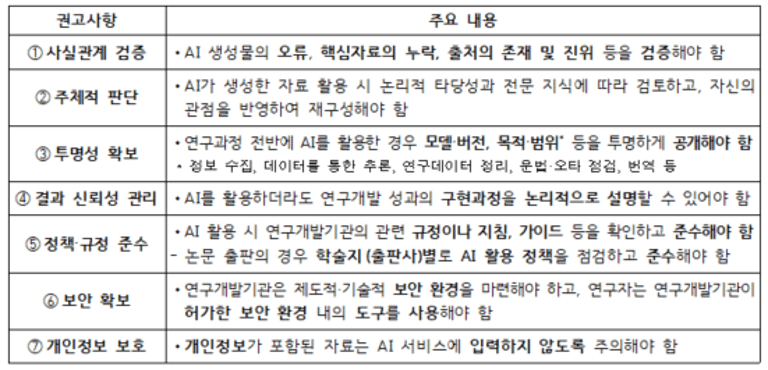

The Ministry of Science and ICT has finalized seven recommendations for the National R&D AI Research Ethics Guide to address risks such as misinformation, bias, and data leaks as AI becomes more embedded in research.
Researchers are urged to verify facts, exercise independent judgment, ensure transparency, manage reliability, comply with policies, protect security, and safeguard personal information when using AI.
The guide, approved by the National Science and Technology Advisory Council’s steering committee, tackles ethics issues from AI use in national R&D, including misinformation, bias, data leaks, and unclear citations.
Disparities in AI access based on institution size are noted, with calls for publicly provided secure AI infrastructure and large language models for smaller institutions outside major regions.
Researchers must disclose the AI model and version, state the purpose and scope, explain how results are implemented, and ensure AI-derived content can be reconstructed to align with their analysis.
The debate centers on balancing research autonomy with safeguards, focusing on what AI did and what humans verified rather than simply whether AI was used.
Institutions are urged to create secure AI-use environments, approve tools, and avoid entering personal data into external AI services.
Security concerns include restricting access to AI tools, with risks that overly tight limits could degrade research quality or push researchers toward unofficial uses.
Scholars advocate clarifying enforcement measures, including casebooks of AI misuse and clear disciplinary actions for abuses like hidden prompts.
Experts argue the guidelines may not reflect current research realities, as AI is used for hypothesis generation, planning, and methodology, suggesting a need for broader scope and flexibility.
Evaluators of national R&D projects and papers must perform assessments without external AI services or hidden prompts to manipulate results.
There are explicit prohibitions on inputting materials under review into external AI systems and warnings about manipulating AI assessments through hidden prompts.
Summary based on 2 sources
Get a daily email with more AI stories
Sources
!["AI as an Auxiliary Tool, Responsibility Lies with Researchers"...Scientific Community Raises Concerns over Government Research Ethics Guide [Reading Science] - The Asia Business Daily](https://cdn.brief.news/cdn-cgi/image/fit=contain,width=160/images/links/42aa722dda78f31d719df9258c89a6550dfaebce64e434935e2dd2f3b52417fff3810a18df859e1ca7c955f5aba873937ed4ac98bbb597b6be6ad8e327fb429c.jpg)
DigitalToday • Sep 20, 2026
South Korea sets AI research ethics guidelines for national R&D, final responsibility rests with researchers