AI in Data Quality Market Set to Soar, Reaching $4.47 Billion by 2030
September 23, 2026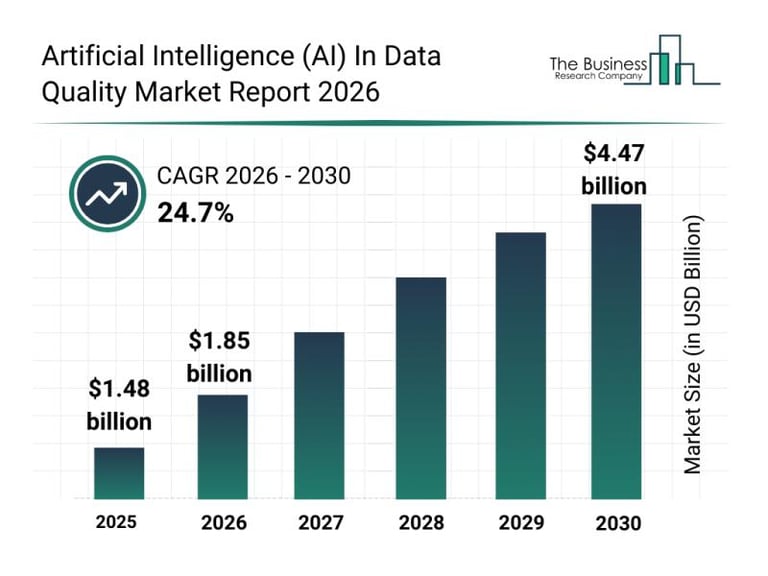

The AI in Data Quality market is expanding rapidly as enterprises grapple with growing data volumes, governance needs, regulatory reporting, and cloud adoption, with value rising from about $1.48 billion in 2025 to $1.85 billion in 2026 (25% CAGR) and projected to reach $4.47 billion by 2030 (roughly 24.7% CAGR).
The 2026 market outlook includes enhancements like market attractiveness scoring, TAM analysis, company scoring visuals, forecasting dashboards, market hotspots graphics, and insights on key technologies and future trends, produced by The Business Research Company.
Market segmentation covers components (Software, Services), deployment (Cloud, On‑premise), organization size (SMEs, Large Enterprises), and verticals (BFSI, IT/Telecom, Healthcare, Retail/E‑commerce, Manufacturing, Government/Public Sector, Other), with subcategories such as data profiling, cleansing, monitoring, integration, MDM, metadata management, and predictive analytics, plus professional, managed services, consulting, implementation, and training/support offerings.
Leading players include Alphabet, Microsoft, AWS, IBM, Oracle, SAP, Salesforce, Snowflake, Databricks, Precisely, Informatica, SAS, Teradata, Collibra, Dataiku, QlikTech, and Ataccama, with a notable 2024 move where QlikTech acquired Kyndi to boost NLP and AI capabilities.
GenAI is increasingly used to improve data accuracy and efficiency, highlighted by Saama Technologies’ 2023 Data Quality Co-Pilot that auto-generates validation code from user-described checks, significantly reducing manual work in areas like clinical trial data.
Key growth drivers include expanding AI-powered analytics, real-time data accuracy demands, data fabric architectures, automation in data operations, and tighter compliance, alongside trends in automated data cleansing, AI-driven anomaly detection, continuous data quality monitoring, predictive data management, and self-learning data validation models.
Summary based on 1 source