Korea's AI Competitiveness Hinges on Data Quality and Federated Learning Innovations
September 27, 2026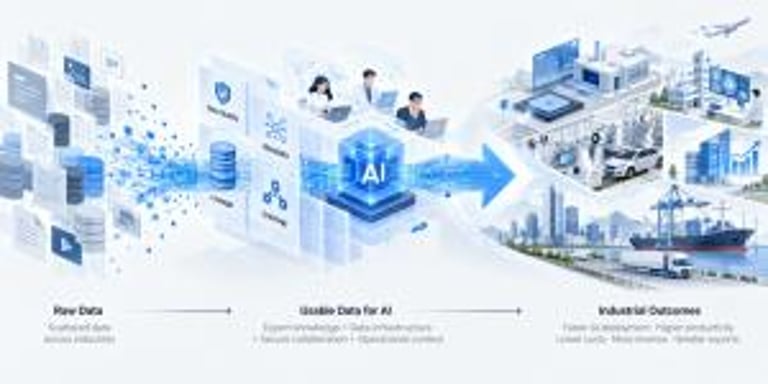

The piece argues competitiveness now hinges on data quality, context, and verifiable operational results over sheer data volume, tying to a Korea IT Times series on Data as National Infrastructure.
Snorkel AI signals include a roughly $3.5 billion valuation and annualized revenue over $375 million, underscoring strong market interest in data-centric AI tooling.
Korea must turn data into usable, evaluable, and revenue-generating capabilities to prove competitiveness in the AI era.
Federated learning offers a path for cross-institution collaboration with privacy safeguards, requiring secure aggregation and clear rewards for contributions.
Operational governance is essential for AI agents to act safely within real enterprise systems, demanding governance, security policies, ownership clarity, traceability of evidence, and accountable outcomes.
Policy success should be measured by real economic impact—faster AI deployment, productivity gains, cost reductions, private investment, and export growth—rather than data volume alone.
Snorkel AI’s funding and rising revenue signals growing demand for specialty data and evaluation environments, signaling a shift toward training and evaluation ecosystems.
Valuation of Snorkel AI is not Korea’s target; the focus should be on tangible outcomes: shorter development cycles, lower costs, higher productivity, new revenue, and exports.
Industry leaders emphasize foundational data infrastructure elements: quality-assured usable data, data valuation, secure distribution, and alignment of data fabric with metadata, lineage, and ontology.
Korea’s data policy should feature a performance scorecard tracking time-to-market for AI services, cost reductions from data cleaning and integration, productivity gains, and revenue/export growth tied to data-based services.
Data policy should allow keeping raw data within institutions while enabling collaborative training, with federated learning requiring privacy safeguards and clear contribution metrics.
Summary based on 1 source
Get a daily email with more AI stories
Source
Korea IT Times • Sep 27, 2026
Data as National Infrastructure, Part 6 | Korea’s Data Competitiveness Rests on Verifiable Results