Lakebase Vector Revolutionizes Postgres Search with Scalable Hybrid Vector-BM25 Integration
September 28, 2026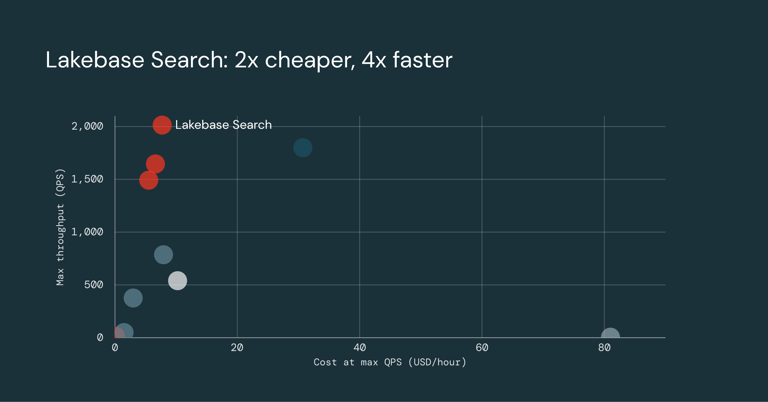

Databricks unveils Lakebase Search, a built-in search engine for Lakebase Postgres, delivered as two extensions: lakebasevector for approximate nearest-neighbor search and lakebasetext for BM25 full-text search, generally available on AWS and Azure.
Lakebase Search includes BM25 text search (lakebase_text) that improves over traditional tsvector by weighting rare terms with global IDF and speeding top-K results through upper-bound pruning, enabling efficient hybrid queries.
Databricks positions Lakebase AI Search as a managed alternative for high-quality retrieval, while Lakebase Search aims to consolidate operational data and search within a single database.
Databricks highlights three vector-search pain points: high costs at scale due to in-memory indices, long index builds and write bottlenecks, and limited parallelism for single queries.
Benchmark claims tout twice the throughput of the next best system and four times lower cost than a cloud Postgres with pgvector, though results are company-generated without external validation.
The vector-search architecture can serve up to 100 million vectors per Lakebase Compute Unit by caching hot data and decoupling storage from compute, enabling scale-to-zero when idle.
Index construction is distributed across cores via LTAP to offload builds from the primary database to distributed engines like Spark, cutting build times to minutes.
Conexiom reports BM25 hybrid search over over 100 million rows with half the compute footprint of its prior pgvector setup, reducing costs threefold and tripling throughput.
As a concrete example, Conexiom achieved roughly 3x lower infrastructure costs and 5x higher throughput with Lakebase Vector versus pgvector by enabling hybrid search and unifying OLTP and search workloads.
Lakebase uses a storage-backed index approach with hierarchical inverted-file clustering and RaBitQ quantization, claiming 100 million vectors at 97% recall with about 71 ms P99 latency in benchmarks.
Post-GA signals to monitor include reproducible performance against tuned pgvector and DiskANN, adoption by teams consolidating search pipelines, and competitive responses from pgvector and others.
Lakebase_vector reports strong performance, with 71 ms P99 latency at 97% recall on 100 million vectors, claiming higher throughput and lower cost than pgvector-based setups.
Summary based on 3 sources
Get a daily email with more AI stories
Sources

Unite.AI • Sep 28, 2026
Databricks Brings Full-Text and Vector Search to Lakebase Postgres
Databricks • Sep 28, 2026
Lakebase Search: State-of-the-art full text and vector search for Postgres