AI Gateways Revolutionize Cost-Effective Model Routing with Batch APIs and Multi-Provider Integration
September 29, 2026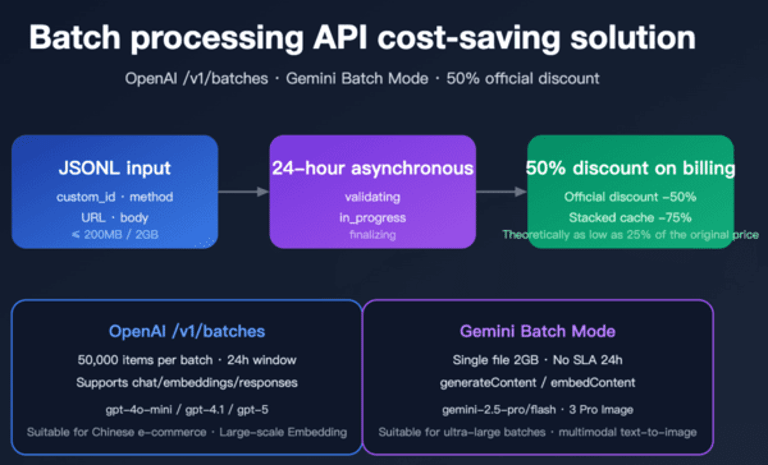

Multi-model routing and load balancing pick cost-effective, fast models for tasks, using examples like Tencent Cloud’s TokenHub and Tencent Cloud–Cafe24 partnerships to optimize model choice by price, latency, and availability.
Overseas providers such as OpenRouter, Portkey, LiteLLM, and Cloudflare AI Gateway show diverse approaches, with some regions embedding capabilities into broader cloud or security platforms rather than offering standalone gateways.
Asynchronous batch APIs process large volumes of requests without real-time responses, often with discounts, as seen with OpenAI batch pricing, AWS Bedrock, and services like OpenRouter and Portkey that unify or batch multiple providers.
Future directions include cache-aware routing, cost-per-result optimization, and hybrid routing that blends public APIs, cloud models, and open-source options, all with governance, FinOps, and anomaly detection integrated into gateways.
Fallback and resilience are core gateway features, automatically switching to alternative models or providers during outages or performance dips, with examples like LiteLLM managing multi-account deployments.
OpenRouter connects hundreds of models and providers through a single API for batch submissions and status tracking, while Portkey standardizes formats and offers Immediate Batch for parallel processing across providers.
AI gateways cut token costs via prompt caching, asynchronous batch APIs, and prompt/context compression, while optimizing for price, latency, and availability.
Market data show extremely high daily token usage, driving cost-management focus; tools like /cost and /context help users monitor usage and make informed model choices.
Summary based on 1 source
Get a daily email with more AI stories
Source
![[AI Costs③] AI Gateways Emerge as Key Tool for Cutting Token Costs](https://cdn.brief.news/cdn-cgi/image/fit=contain,width=160/images/links/842b85ae0b37a249cb352cfe428ffb243d9d3d007fb0ffb0212a8983db7d3a09d605cb1eaa5e8829427fbc8b656113f979db8458188a882516770b1d8e6f0d98.png)
The Elec Inc. • Sep 29, 2026
[AI Costs③] AI Gateways Emerge as Key Tool for Cutting Token Costs