Enterprise AI Evolves: From Simple API Flow to Advanced Layered Architecture with Enhanced Security and Observability
September 29, 2026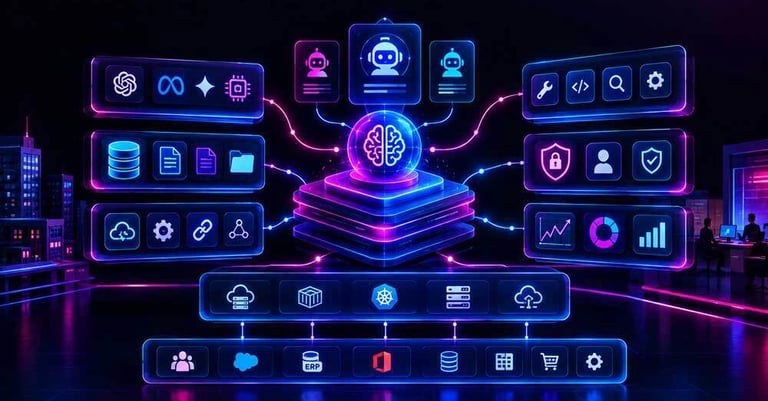

Enterprise AI is evolving from a simple App → LLM API → Response flow to a layered architecture that includes App, AI Gateway, Model, Agent, Tools, APIs/DB/SaaS, and Business Action, with added requirements for security, observability, state management, and deployment infrastructure.
To support debugging and reliability, implement detailed observability by logging agent_id, task_id, tool, arguments, result, latency, cost, and policy decisions.
Adopt a controlled data retrieval approach where agents fetch only the data they need, rather than sending entire databases into model context.
Expose core business capabilities as tools (such as get_customer, search_orders, create_ticket, update_ticket) and restrict model access to internal networks for security.
Agent runtimes require more than inference, including state management, tool calls, retries, sessions, sandboxing, and support for long-running execution.
Treat AI workloads as production software, establishing development, testing, deployment, and monitoring stages; avoid launching autonomous workflows directly from prototypes.
Propose a concrete stack: Frontend → Backend/API → AI Gateway → Agent Runtime → Tool Gateway with CRM, Database, Search, and Internal APIs, plus supporting services for Identity, Secrets, Observability, Evaluation, Policy, Storage, and Deployment.
Security must go beyond authentication to include identity, authorization, secrets management, sandboxing, network policies, and tool permissions, aligning with advanced safety frameworks.
Centralize model orchestration with a model gateway that routes through an AI Gateway and a Model Provider to simplify future model changes.
The enterprise AI application is becoming a software system built around a model, rather than a model merely embedded in a traditional app.
Summary based on 1 source
Get a daily email with more Tech stories
Source

DEV Community • Sep 29, 2026
Enterprise AI Platforms in 2026: What Developers Actually Need to Build