Comprehensive Guide: Building a Multi-Agent AI System on Amazon EKS for Enterprise-Scale Use in 2026
October 8, 2026

A production-ready blueprint outlines step-by-step provisioning for a multi-agent AI system on Amazon EKS, starting with foundation VPC and IAM roles, then building a company knowledge store in S3 with OpenSearch Serverless and Bedrock Knowledge Base, and finally implementing Bedrock Guardrails and core Python agents with a shared BaseAgent for knowledge retrieval, guarded model invocation, human-approval checks, and metrics.
Security, governance, observability, and reproducibility are central: enterprise-grade protections (WAF, private networking, authenticated access), human approval gates for sensitive actions, CloudWatch metrics, and a line-by-line infrastructure and codebase ready for deployment.
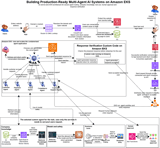
User requests flow through a secure chain from frontend to internal agents via a Custom Agent Router; each agent reads company knowledge from S3 and OpenSearch, queries Bedrock with guardrails, and requires human approval for sensitive actions before verified responses are returned.
Architectural workflow integrates AWS services end-to-end—from Route 53 and CloudFront through WAF, Cognito, API Gateway, VPC, ALB, and EKS—culminating in five specialized agents (Customer, Payment, Fraud, Compliance, Customer Support), a Custom Agent Router, Bedrock Guardrails, and human-approval gates.
The article provides a complete, production-grade blueprint for building a multi-agent AI system on Amazon EKS, detailing architecture, components, and end-to-end data flow designed for enterprise-scale use in 2026.
Core infrastructure includes a VPC with public and private subnets, private EKS nodes, an IAM role with Bedrock and S3/DynamoDB permissions, and dense policies enabling Bedrock operations, knowledge access, and human-approval messaging.
Knowledge and data storage center on a dedicated S3 bucket for company documents, synchronized to S3, with OpenSearch Serverless for vector embeddings; Bedrock Knowledge Base ingests S3 content and uses OpenSearch for vector search to enable retrieval-augmented generation.
Prerequisites include a broad set of AWS services (Route 53, CloudFront, WAF, S3, Cognito, API Gateway, VPC, ALB, EKS, Bedrock, OpenSearch, Lambda, Step Functions, CloudWatch) and development tools, with setup estimated at three to four hours.
The five specialist agents—Customer, Payment, Fraud, Compliance, and Customer Support—inherit from a common BaseAgent, each with tailored prompts and checks for human approval, plus mechanisms to retrieve knowledge, invoke Bedrock with guardrails, and publish performance metrics to CloudWatch.
Bedrock Guardrails constrain model outputs across all five agents, enforcing safety policies with domain-specific content filters, sensitive-information masking, and refusal messaging when policies are breached.
Summary based on 1 source