Tesla's Optimus Robot Revolutionizes Learning with Massive Video Data
October 10, 2026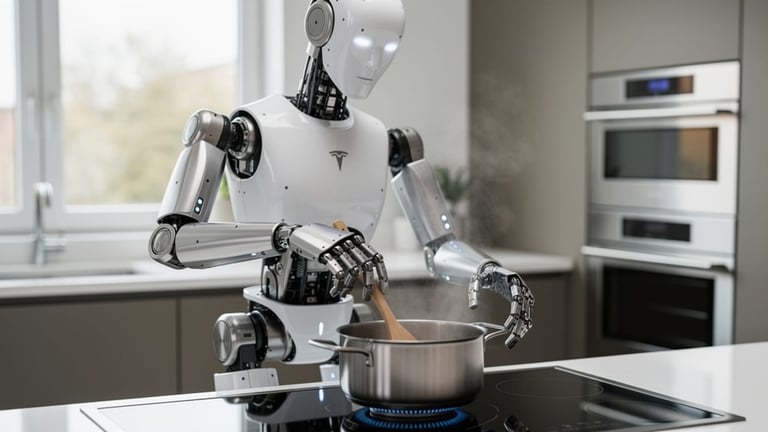

Tesla believes it can accelerate and scale humanoid robot learning by using massive video data, potentially transforming how robots acquire new skills.
In factory settings, Optimus can perform tasks like identifying and moving a Model X fore link, and can follow natural-language commands, highlighting relevance to production lines.
Tesla has shifted from motion-capture and direct teleoperation to video-based imitation learning for Optimus.
Tesla has not published failure rates or task-specific success metrics, and the claims emphasize learning potential rather than full autonomous capability in kitchen-like environments.
Elon Musk noted that Optimus training needs could be at least ten times those of Tesla’s self-driving programs, underscoring the complexity of real-world robotic learning.
Teleoperation scales poorly for training data, while video-based learning scales much faster, with in-house camera rigs used for data collection.
Industry context: rivals rely on teleoperation and simulation, but Tesla’s approach could bypass bottlenecks by leveraging vast internet-scale video data.
Optimus can learn two-handed chores largely by watching first-person videos of humans, reducing reliance on teleoperation.
The shift is likened to moving from curated datasets to open web data in large language models, suggesting a potential paradigm shift for robotics training.
Tesla plans to expand training to generic internet video, including unlabeled third-person footage, which could dramatically increase data and scale.
A single neural network trained on first-person task footage enables Optimus to perform multiple tasks such as vacuuming, stirring food, taking out trash, and sorting auto parts.
Summary based on 1 source
Get a daily email with more AI stories
Source
Startup Fortune • Oct 10, 2026
Tesla Says Optimus Learned to Do Chores Just by Watching Humans on Video