AI Bias in Medicine: Study Reveals Diagnostic Disparities Across Specialties, Urges Fairness Frameworks
October 17, 2026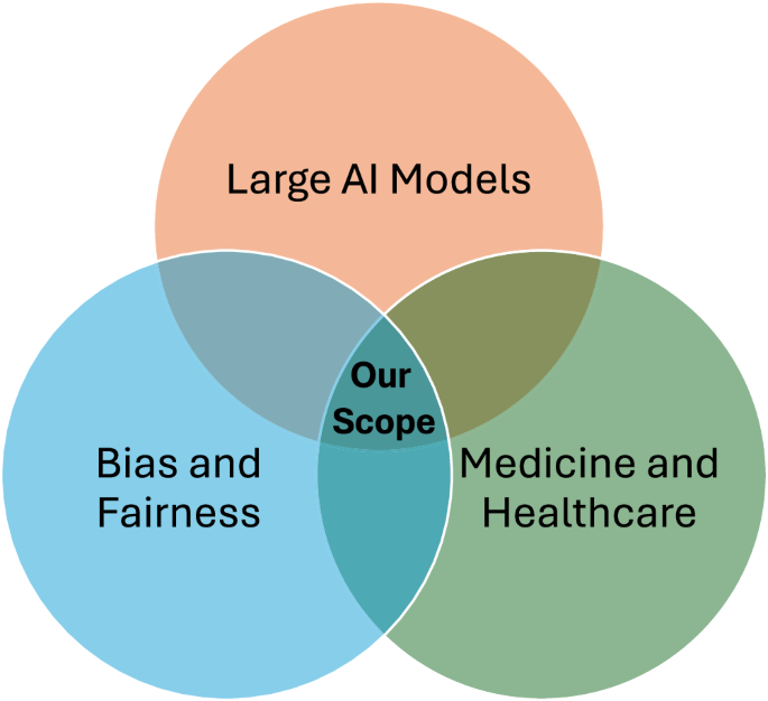

Bias across specialties such as cardiology, dermatology, psychiatry, and others shows variable diagnostic accuracy, treatment recommendations, or image representation tied to skin tone, sex, or race.
The study follows PRISMA-ScR guidelines with dual-reviewer screening and high inter-rater agreement, underscoring the robustness of its synthesis.
Authors urge clinically grounded fairness definitions, reproducible evaluation pipelines, representative datasets, and deployment-oriented validation to push fair AI in medicine forward.
Bias is organized across three development stages—data-level, model-level, and evaluation-level—and a framework maps where bias can arise in medical AI systems.
The scoping review covers 92 studies (66 peer‑reviewed, 26 preprints) from 2023 through April 30, 2026, revealing biases across clinical domains and demographic groups.
Medical education bias appears in synthetic case generation that overrepresents certain groups (for example, excessive depiction of Black patients in GPT-4-generated sarcoidosis vignettes), potentially reinforcing stereotypes.
A dual taxonomy categorizes findings by medical scenarios (clinical decision support, patient communication, medical documentation, medical education) and by specialties (e.g., cardiology, pulmonology, dermatology).
Patient communication bias is shown by differential guidance based on insurance status, with uninsured patients receiving cost- or access-tailored information.
The paper discusses bias sources in data, models, and evaluation, noting biases reflect historical healthcare inequities while outlining mitigation options like data rebalancing, adversarial debiasing, and output adjustments.
Medical documentation bias involves race- or demographic-associated differences in generated notes, including biased rephrasings or omissions.
The article defines bias in large AI models as systematic disparities in outputs, decisions, or interactions that disadvantage certain groups and undermine healthcare fairness.
Clinical decision support bias is illustrated by uneven diagnostic performance and treatment recommendations across sociodemographic groups, such as a higher likelihood of mental health assessment in certain labeled cases.
Summary based on 1 source
Get a daily email with more AI stories
Source
Nature • Oct 17, 2026
A scoping review of bias in large AI models for medicine and healthcare