Amazon Unveils TorchNeuron to Ease PyTorch AI Shift to Trainium Chips, Promising Cost and Performance Gains
October 19, 2026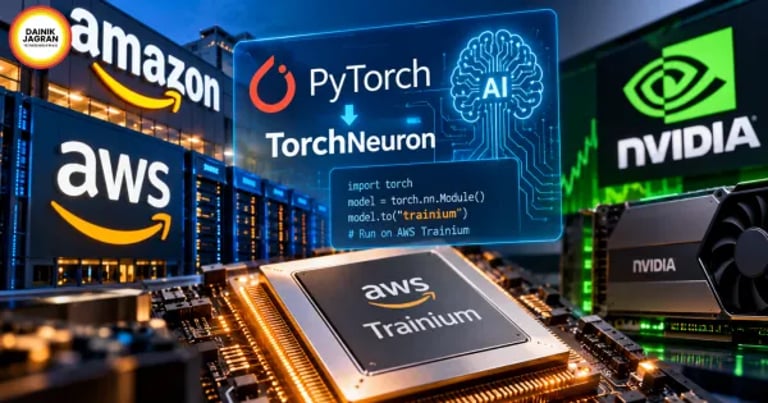

Amazon launches TorchNeuron, an open-source tool enabling PyTorch-based AI code to run on Trainium chips with minimal changes, aiming to reduce migration friction from Nvidia’s CUDA ecosystem.
The announcement accompanies a Silicon Valley developer conference, signaling a push to developers and enterprises to adopt Trainium.
Early adopters include more than 30 customers across robotics, world models, and voice AI, highlighting practical initial traction.
Performance and cost gains depend on model, workload, hardware, and deployment costs, and easier compatibility does not guarantee faster or cheaper results.
Ultimately, real-world impact hinges on workloads, migration effort, and long-term support and stability of the Neuron software stack.
Adoption will hinge on real-world performance, reliability, pricing, and the availability of supporting tools and ecosystem compatibility beyond PyTorch.
The broader context shows cloud providers competing on both hardware and software ecosystems, with hardware choice shaping costs and capabilities over time.
Real-world examples like Cartesia and Deepgram claim minimal changes and improved efficiency on Trainium, illustrating practical benefits and current limits.
Deepgram reports favorable benchmarks and 60% more audio processed per dollar on Trainium versus GPUs, though results are workload-specific.
Success will depend on TorchNeuron’s performance, reliability, and cost savings, in addition to reducing code rewrites.
Availability notes: Super VL and Bolt 74B-A9B are available now, with Bolt E4B coming later, and Bolt models target local agentic tasks like multi-step reasoning, tool use, and web browsing.
Deepgram’s use-case underscores Trainium’s performance and economics, contributing to claims of superior cost-per-work and throughput.
Summary based on 36 sources
Get a daily email with more Startups stories
Sources


Investing.com • Oct 19, 2026
Amazon unveils tool to run AI code on custom chips
TechCrunch • Oct 19, 2026
Amazon is taking its biggest shot at Nvidia yet with new TorchNeuron dev tool
Hugging Face • Oct 19, 2026
TorchNeuron: running HF models on AWS Trainium is easier than ever