Agentic DevOps: Revolutionizing Cloud Infrastructure with Autonomous, Closed-Loop Platforms
October 21, 2026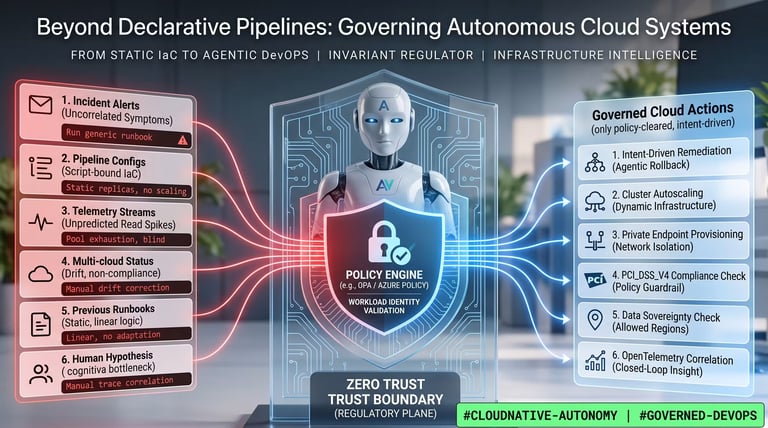

The article centers on Agentic DevOps—a closed-loop architecture with five stages: Observation through telemetry, Reasoning with enterprise context graphs, Decision via model context protocols, Execution guarded by invariant policies, and Verification with continuous feedback and automatic rollback if needed.
Platforms should offer machine-readable golden paths by exposing typed tool contracts and APIs so both humans and autonomous actors apply identical security and compliance controls.
Current IaC lacks runtime adaptability; static tools like Terraform and Bicep can’t respond during events such as traffic spikes, leading to delays and toil.
An intent-driven Azure Landing Zones concept envisions workloads provisioned by interpreted intents that generate validated infrastructure definitions and enforce governance.
Intelligent FinOps integrates cost management into runtime, enabling predictive resource allocation, continuous capacity arbitrage with spot/preemptible instances, and tying cost per unit to telemetry data.
Guardrails demonstrated with Open Policy Agent: production mutations are denied unless sandbox verification is cleared, illustrating deterministic control over autonomous actions.
The architectural evolution moves from manual scripts and static golden paths toward self-service, machine-readable intents, and autonomous remediation, reducing cognitive load while changing operational interfaces and scaling.
Practical implementations are discussed, including concrete examples and use cases.
Security and control emphasize a zero-trust control plane for autonomous agents, employing ephemeral workload identities (Microsoft Entra ID, SPIFFE), policy-as-code guardrails, and separating reasoning from execution.
The cloud engineering role shifts from manual configuration and firefighting to designing robust platform boundaries, governance, observability, and human-in-the-loop controls, enabling self-healing and autonomous optimization with ongoing strategic oversight.
The piece argues declarative IaC is insufficient for modern distributed clouds and advocates Agentic DevOps, embedding cognitive reasoning within policy boundaries to create autonomous, closed-loop platforms.
An AKS example of agentic incident triage and automated rollback shows end-to-end automated detection, root-cause analysis, guarded rollback, and verification.
Summary based on 1 source