Tesla Unveils Real-Time Mapping System for Self-Driving Cars, Revolutionizing Navigation with AI and Fleet Learning
October 22, 2026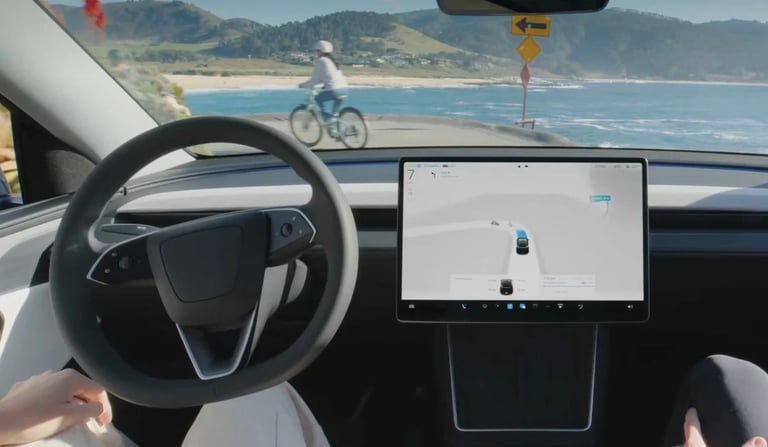

Tesla is building its own real-time mapping system for Full Self-Driving that infers road geometry on the fly from camera data using an autoregressive transformer, eliminating reliance on pre-built HD maps.
Among owner-facing features to watch are a voice instruction tool that preserves location-specific commands across trips, with fleet-learning improvements delivering gradual performance gains on regular routes.
Fleet learning combines driving data from the entire Tesla fleet, more than a billion miles annually, to inform FSD decisions in unusual or difficult scenarios, alongside learning from individual drivers’ styles.
FSD version 14.2.2.5, rolled out in March 2026, adds a routing engine that fuses navigation into the vision network, shifting core planning away from external routing APIs.
Tesla trains its unified end-to-end model on the Dojo supercomputer using labeled video data, a framework that could also feed the company’s Optimus humanoid-robot project.
While Google Maps remains the visual interface on the touchscreen, driving decisions are powered by proprietary routing (Valhalla on Tesla servers) and the end-to-end architecture that operates independently of third-party map data.
Tesla aims to learn driver preferences through spoken, contextual instructions and remembers these preferences for future trips to enable personalized driving behavior.
The new approach treats road geometry and lane connectivity as a live inference problem, with FSD generating a live lane graph without consulting pre-drawn maps.
Summary based on 1 source
Get a daily email with more AI stories
Source

BASENOR • Oct 21, 2026
Tesla Is Building Its Own FSD Maps — Here's How It Works