WorldTUI: Revolutionizing Terminal Interaction with AI-Powered Screen Updates via WebGPU
October 22, 2026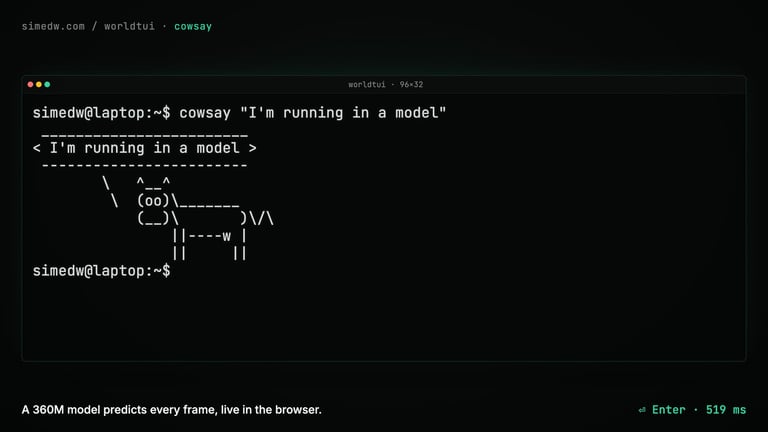

WorldTUI is a browser-based demonstration that fine-tunes a 360M-parameter language model to act as a terminal, predicting screen updates for each keypress rather than generating plain text.
Limitations include imperfect consistency where files can be misread after edits, slower performance in Firefox compared with Chrome, and no internet access for Docker containers, which reduces tool availability and reliability of complex operations.
Training data were generated by running commands in Docker, yielding about 336k episodes and ~2B tokens, with a DAgger-style correction loop helping the system learn from its own mistakes to improve reliability.
The project prioritizes exploration over practicality, with future work aiming to train on thousands of applications to improve generalization and exploring diffusion-based screen updates instead of autoregressive decoding.
The model, based on Qwen2.5-Coder-0.5B and trained on real terminal sessions, can perform tasks such as creating files, using vim and tmux, playing snake, and maintaining some memory across commands.
A downloadable 208 MB browser demo is provided, with ongoing efforts to publish the weights to test how far a small model can emulate interactive applications within a constrained environment.
Performance highlights include in-browser inference via WebGPU with int4 quantization (208 MB), achieving near real-time typing (~60 ms per keystroke) and substantial speedups from parallel row decoding (p95 latency dropped from 6.7 seconds to 0.87 seconds on an RTX 4090).
Key technical innovations feature a tiny 333-token vocabulary for screen updates, per-row parallel generation to speed updates, and a speculative decoding approach to verify and correct parallel drafts, dramatically lowering end-to-end latency in the browser.
The terminal is modeled as a grid of characters; inputs are raw keypress bytes and outputs are specific screen updates and cursor positions, enabling screen redraws without relying on a traditional filesystem behind the scenes.
Summary based on 1 source
Get a daily email with more Startups stories
Source
Simon Edwardsson • Oct 21, 2026
WorldTUI: I trained a 360M model to pretend to be a terminal