AI's Undervalued Growth: Urgent Call for Early Infrastructure Investments to Avoid Future Costs
October 31, 2026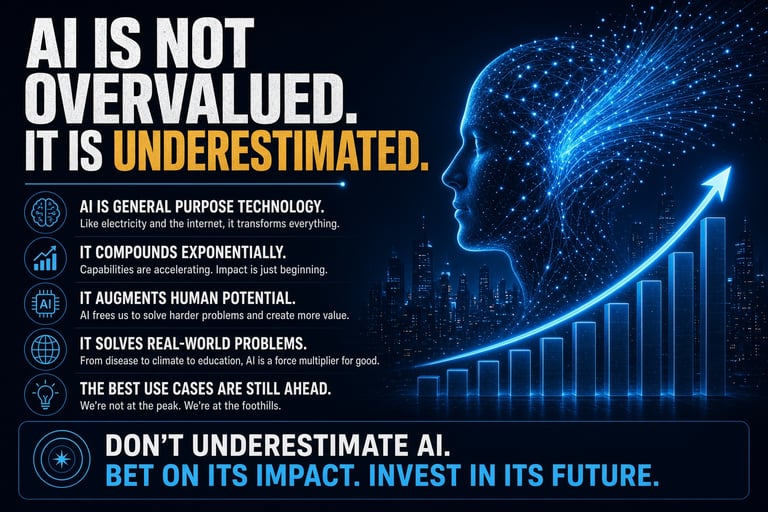

The analysis argues AI isn’t overvalued in the long run, but its speed and scale of capacity are underestimated, urging executives and policymakers to measure cost of delay like investment and to act early to secure capacity to avoid higher future costs.
Alphabet’s Q3 2026 results show massive ongoing infrastructure investment, with $51.4 billion in quarterly capex, guidance of $195-205 billion for the year and expectations of higher 2027 spending, alongside strong cloud growth and Gemini reaching 1 billion users.
AI adoption now extends beyond tech giants into manufacturing, logistics, finance, and science, with pilots giving way to commercial use and rising humanoid-robot shipments signaling AI moving into actuators as well as screens.
Despite widespread data-center opposition and regulatory frictions, bans generally relocate supply rather than reduce demand, often raising effective costs for the same AI capability.
As AI matures, transparency, standards, and verification become essential; there will be higher evidence standards for policy and market claims, and labor displacement will require education, credentialing, and capital-market adjustments.
AI is becoming the operating layer of the new economy, with compute as the scarce input and models converting compute into capability; those who secure both will gain productivity and decision advantages, while others face higher costs or delayed access.
Industry patterns show hyperscalers—Amazon, Microsoft, Meta, Alphabet—planning hundreds of billions in capex for 2026 to meet power, chip, and data-center capacity needs, driven by strategic imperatives beyond mere finance.
Policy should be pragmatic: negotiate pricing and siting standards rather than bans, and use existing electricity, water, and noise regulations to mitigate local externalities while preserving national capacity and competitiveness.
Demand and capacity constraints are real, with demand repeatedly outpacing planned capacity; there is a large cloud backlog and substantial purchase commitments as of late 2026.
Underinvesting in compute poses greater risk than overinvesting, so AI infrastructure should be treated as a strategic vector rather than a discretionary expense for nations and firms.
Summary based on 1 source
Get a daily email with more AI stories
Source

Live Trading News • Oct 31, 2026
AI Is Not Overvalued. It Is Underestimated.