Enterprise AI Spending to Hit $176.8 Billion by 2026, Driven by Autonomous Agents
November 3, 2026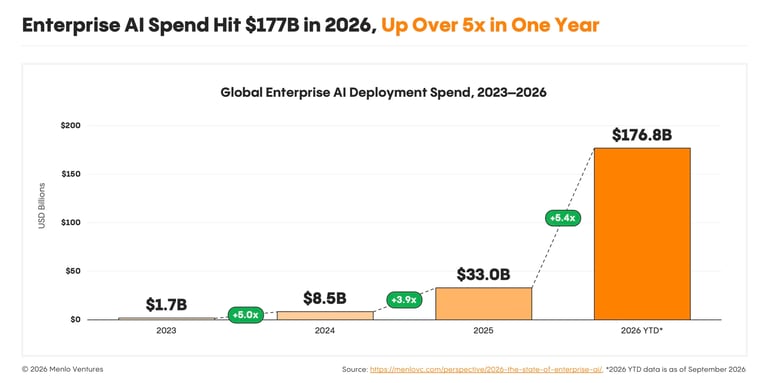


Enterprise AI deployment spending has surged to an annualized $176.8 billion in 2026, up from $33 billion in 2025 and $1.7 billion in 2023, with Anthropic, OpenAI and Google together capturing 69% of deployment spend.
The jump reflects deeper adoption by existing buyers as well as market growth: enterprise penetration rose from 55% to 65%.
A major force behind that expansion is AI agents, which generated about 80% of tokens on OpenRouter—roughly seven times human-generated volume—though the platform’s data is not a measure of all enterprise use.
Open-source models show a sharp divide between usage and spending, accounting for 19% of tokens but just 4% of enterprise AI spend, a gap Menlo attributes to lower prices.
Chinese vendors capture 89% of open-source enterprise model spending, led by Moonshot AI’s Kimi at 61%, followed by DeepSeek at 15%, Zhipu’s GLM at 11% and Qwen at 3%; Meta’s Llama holds 7%.
As agents take on more work, infrastructure is changing too: 74% of builders use agents to manage workflows, while databases are being rebuilt for machine-speed, short-lived usage and demand grows for sandboxes, search and browser infrastructure.
Healthcare is the largest AI vertical in the report, with U.S. spending estimated at $3.7 billion in 2026—2.5 times the prior year—with providers accounting for 77%.
Healthcare-specific AI adoption reached 42% of organizations in 2026, up from 22% in 2025, even as purchasing grows more competitive and sales cycles stretch to 10 months for health systems and 11 months for outpatient providers.
Growth is shifting from administrative tools toward patient care: clinical copilots expanded 5.5-fold to $550 million and patient-engagement AI grew 4.5-fold to $450 million, outpacing scribes, coding and billing.
At the same time, Microsoft and Epic captured 68% of new ambient-scribing spending in 2026, lifting incumbent vendors to 46% of the $950 million market as built-in tools put pressure on AI-native scribe startups.
Payers spent only $150 million on external healthcare AI, about 4% of the market, but 43% said provider AI-assisted coding increased their medical cost trend, up from 23% in 2025; prior authorization became their leading AI priority.
Life-sciences adoption is accelerating: 51% of surveyed pharmaceutical companies now use AI at scale, compared with 15% a year earlier, while spending on life-sciences AI rose 23-fold to $700 million.
Summary based on 10 sources