Mathematician Ma Xiao Joins USTC to Lead AI-Driven Breakthroughs in Scientific Discovery
November 6, 2026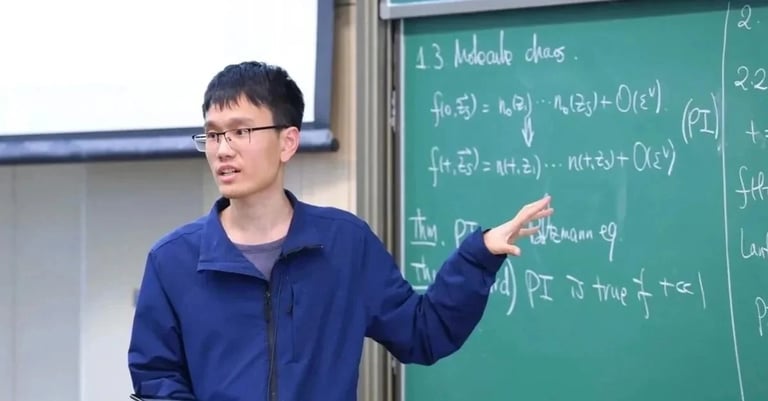

Ma Xiao, a 28-year-old mathematician, left the United States for China to shift focus from pure mathematics to artificial intelligence research, taking professorships at the University of Science and Technology of China (USTC) in Hefei with joint appointments at the Center for Geometry and Physics and the Institute of General Artificial Intelligence.
He returned to China to join USTC and hold professorships at both the Artificial Intelligence General Institute (AGI) and the USTC Institute for Geometry and Physics, solidifying his move toward AI-driven research.
Ma Xiao’s move signals a broader pivot from traditional mathematics toward AI-assisted scientific discovery.
In interviews, Ma suggested powerful AI systems could one day tackle long-standing mathematical challenges like Hilbert’s sixth problem, while noting two potential futures for AI: it could become overwhelmingly powerful or plateau, allowing continued human contribution.
Deng Yu, who received the Fields Medal in July 2026, credited Ma’s guidance as crucial to their breakthrough, saying the team would have taken many detours without him.
Ma Xiao highlighted tools such as Codex, Claude Code, and Git as essential for students entering the AI-assisted research era.
Ma contributed to a breakthrough related to Hilbert’s sixth problem, linking microscopic particle behavior to fluid motion, with Yu Deng and Zaher Hani; the results were published in Annals of Mathematics.
Ma has focused on AI agents that assist scientists, developing an AI-based mathematical proof system called qmd-prover to automate parts of research, including exploring questions, constructing proofs, and checking results.
He plans to pursue general artificial intelligence to automate mathematical discovery and other research aspects, with qmd-prover as a core tool.
Ma indicated he might spend the next two to three years on AI-agent research, while acknowledging uncertainty about whether AI will fully replace human researchers.
Ma Xiao’s early life in Xinxiang, Henan Province, and education—from USTC’s School for Gifted Students to Princeton and then positions in the U.S. and China—frames his career path and the rise of USTC’s Institute of General Artificial Intelligence announced in January.
The breakthrough published in the Annals of Mathematics helped Yu Deng win the Fields Medal in 2026 and led to Ma Xiao securing a research assistant professor position at the University of Michigan.
Summary based on 2 sources
Get a daily email with more AI stories
Sources
VnExpress International • Nov 5, 2026
Mathematician behind century-old breakthrough leaves US for China to pursue AI
vietnam.vn • Nov 5, 2026
The 28-year-old mathematician left the US for China, shifting his research focus to AI.