AI Is Reshaping Search and Shopping—Why Brands Must Earn Trust Across Both
November 22, 2026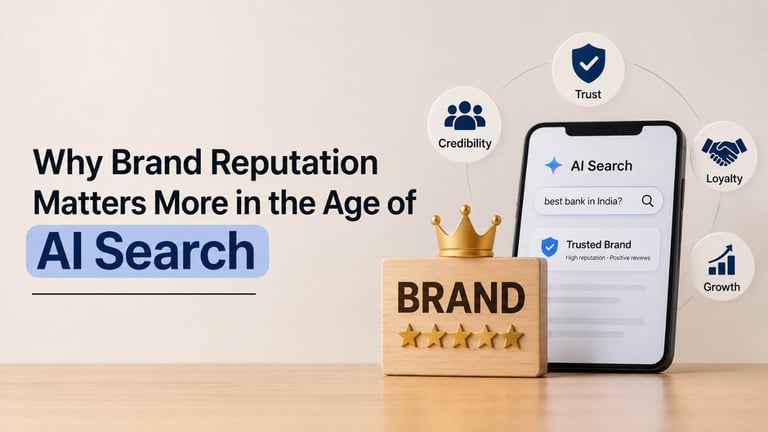

AI-generated answers are reshaping online discovery: instead of competing only for ranked-link clicks, brands now also need to be included, accurately represented and trusted in answers from search engines and assistants.
That shift is already happening at enormous scale: Google reported more than 2 billion monthly users of AI Overviews in 2025, over 100 million monthly active users of AI Mode in the United States and India, and one billion Gemini app users in October 2026, alongside its strongest year-over-year query growth in five years.
AI is also becoming part of the shopping journey: Adobe reported that referrals from generative AI to U.S. retail sites rose 1,300% year over year during the 2024 holiday season and 1,200% between July 2024 and February 2025; its survey found 39% of consumers had used generative AI for online shopping and 53% planned to use it that year.
Visitors arriving at retail sites from AI sources were more engaged, viewing 12% more pages per visit and having an 8% lower bounce rate than visitors from other sources, but their conversion rate was 9% lower—a gap that had narrowed from 43% in July 2024.
The effect on traditional search traffic remains contested: a Pew Research Center study of 900 U.S. adults found users clicked a conventional search result in 8% of visits when an AI summary appeared, versus 15% without one, and more often stopped browsing afterward; Google disputed the study’s methodology and representativeness.
Convenience has not erased consumers’ concerns: Reuters Institute respondents expected AI to make news cheaper and more current but less transparent, accurate and trustworthy, and most often named trusted news brands as their first stop for checking online claims.
Those concerns have evidence behind them: Google acknowledged that some AI Overviews were odd, inaccurate or unhelpful, citing gaps in high-quality content as one contributing factor, while an evaluation by 22 public service media organizations found significant issues in 45% of more than 3,000 responses from four AI assistants.
Third-party coverage appears prominently in AI sources: Muck Rack’s analysis of more than 25 million citations found about 84% came from earned media and 27% were journalistic, but it did not show that brand reputation causes more frequent or favorable AI mentions, and Muck Rack has a commercial interest in the field.
The broader takeaway is that reputation may matter both when consumers assess AI-generated claims and when systems choose sources, but a causal link between reputation and citations has not been established, and findings about trust in news brands may not extend to other industries.
So the practical move is to stay flexible rather than abandon search or assume it is in decline: invest in credibility, authoritative content and earned coverage, keep operating across traditional search and AI experiences, and measure influence inside AI interfaces as well as website clicks.
Summary based on 1 source
Get a daily email with more AI stories
Source

MarkHub24 • Nov 22, 2026
Why Brand Reputation Matters More in the Age of AI Search