GravityXR Unveils World's Lightest Mixed Reality Headset with Advanced Split-Chip Design
December 4, 2025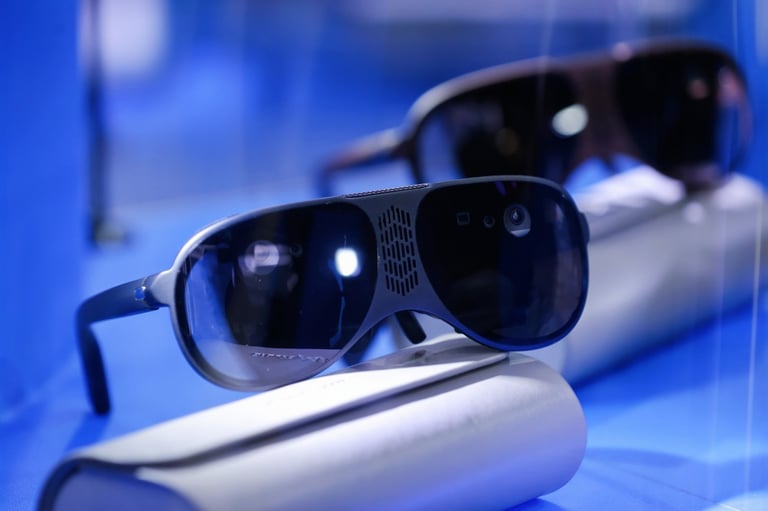

The GravityXR M1 reference headset weighs under 100 grams, uses pancake lenses, and delivers a 90-degree field of view with full-opacity passthrough rendering, making it the lightest headset demonstrated to date and moving toward a mixed reality glasses form factor.
Investors in GravityXR include Goertek, ByteDance, Sequoia China, and Lenovo Capital, signaling broad interest from hardware makers and venture capital in ultralight AR/VR technology.
GravityXR’s G-X100 coprocessor handles latency-sensitive image processing and computer-vision tasks—camera passthrough, positional tracking, hand tracking, and reprojection—with a photon-to-photon latency of 9 milliseconds and a 3-watt thermal design power to enable passive cooling.
The G-X100 is designed to offload main compute to an external puck connected to a general-purpose chipset, such as Qualcomm Snapdragon, allowing the headset itself to remain very lightweight.
GravityXR, a Chinese startup with veterans from Apple and Meta, has developed the G-X100 coprocessor for ultralight mixed reality headsets and is powering a reference design headset, the GravityXR M1.
Industry context shows a clear trend toward shrinking MR headsets from about 0.5 kilograms to glasses-like visors, supported by a split-chip design and open peripheral approach that enables this transition.
GravityXR emphasizes that the M1 is a reference design with no firm commitments to adopt the G-X100 in a commercial headset yet; however, rumors point to Meta and Pico pursuing ultralight headsets next year, potentially with a similar split-chip architecture.
Summary based on 1 source
Get a daily email with more Tech stories
Source
UploadVR • Dec 4, 2025
Chinese Startup Builds Chip To Enable Lightest Ever Headsets