GravityXR Unveils World's Lightest MR Headset with Innovative G-X100 Coprocessor
December 5, 2025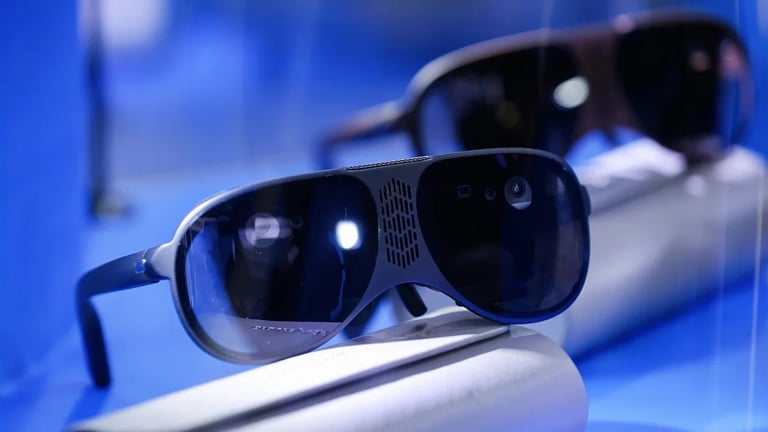

Analysts compare GravityXR’s approach to established devices like Meta Quest 3, Apple Vision Pro, and Bigscreen Beyond to benchmark weight, battery, and display setups.
GravityXR, a Chinese startup with veterans from Apple and Meta, has created the G-X100 coprocessor to power ultralight headsets, anchored by the M1 reference design.
A lightweight reference headset design, GravityXR’s M1, weights under 100 grams and features two 2.5K OLED displays, pancake lenses, four tracking cameras, and two passthrough cameras, with the main compute offloaded to a wired pocket computer.
The G-X100 coprocessor is designed to offload the headset’s main compute to an external puck connected to a general-purpose chipset, enabling a much lighter headset.
Industry context includes investments from ByteDance and collaboration between former Apple engineers and GravityXR in developing ultralight MR tech.
GravityXR’s M1 achieves a 90-degree field of view with full-opacity passthrough rendering, positioning it as the lightest headset demonstrated and moving toward a mixed-reality glasses form factor.
Competitors Meta and Pico are pursuing ultra-lightweight, cable-assisted MR headsets, with Pico eyeing a premium lightweight device in early 2026 and Meta planning a light premium MR headset next year.
Beyond the G-X100, GravityXR also unveiled a smart-glasses chip capable of 16-megapixel photos and 4K 30fps video, signaling broader ambitions beyond VR alone.
The G-X100 supports up to two 4K displays at 120 Hz, dual 16-megapixel passthrough cameras, reverse passthrough, gaze and gesture tracking, with a latency of 9 milliseconds and starting power use at 3 watts.
The Koprozessor G-X100 is introduced to handle sensor data for passthrough, spatial tracking, gaze and gesture tracking with low latency and minimal power draw.
The concept envisions ultralight split-design headsets with external batteries, potentially making devices far lighter than current standalone models like Quest 3 or Vision Pro.
GravityXR notes the M1 is a reference design and no company has publicly committed to using the G-X100 in a commercial headset yet, though rumors point to potential ultralight headset efforts from Meta and Pico next year.
Summary based on 2 sources