Bitcoin’s Five-Year Return Just 10% as ‘Digital Gold’ Case Weakens
November 23, 2026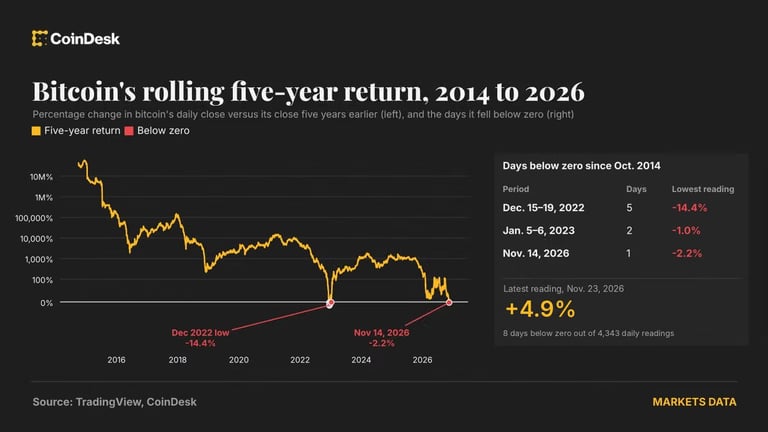

Bitcoin’s five-year return was only about 10% before inflation as of Nov. 23, 2026: an investment of $1 on Nov. 18, 2021, would have grown to roughly $1.10, and the rolling five-year return had briefly turned negative days earlier.
That muted performance fits a broader pattern: Bitcoin’s familiar four-year halving cycles have delivered sharply diminishing peak-to-peak gains, from about 42 times in 2013 to 16 times, 3.5 times and 1.8 times by 2025.
Bitcoin reached a record above $126,000 on Oct. 6, 2025, but was about 49% below that level at the time of writing; another bull run remains possible, though the author argues its gains may be smaller.
The author also challenges Bitcoin’s reputation as “digital gold” or a safe haven, pointing to 90-day annualized volatility of 39%, compared with 5% for EUR/USD, and a 77% fall from November 2021 to November 2022 as inflation rose and interest rates increased.
Institutional adoption via spot Bitcoin ETFs took off in 2024–25, but cumulative net inflows declined from a peak of $62.77 billion on Oct. 9, 2025, to $54 billion on Nov. 18, 2026.
Bitcoin-backed lending is growing, yet the author says high volatility could limit wider institutional adoption and criticizes companies whose main business is holding crypto rather than operating businesses.
The author argues governments are unlikely to make Bitcoin a major reserve asset because it is not widely used for trade, borrowing or collateral, generates no yield and does not directly produce economic output; crypto-collateralized lending totaled $56.16 billion at the end of the second quarter, versus more than $40 trillion in U.S. federal debt.
The U.S. Strategic Bitcoin Reserve, created by an order Trump signed on March 6, 2025, holds Bitcoin forfeited in criminal and civil cases rather than buying large quantities, while the article says the Trump memecoin left many buyers with losses.
With those investment narratives losing force, the author says Bitcoin’s price increasingly depends on risk appetite, dollar liquidity and Federal Reserve interest-rate policy, casting it as something like a continuously traded Wall Street VIX fear index.
Summary based on 1 source