Breakthrough in CO2 Capture: Chiba University Develops Nitrogen-Doped Carbon for Efficient Desorption
March 28, 2026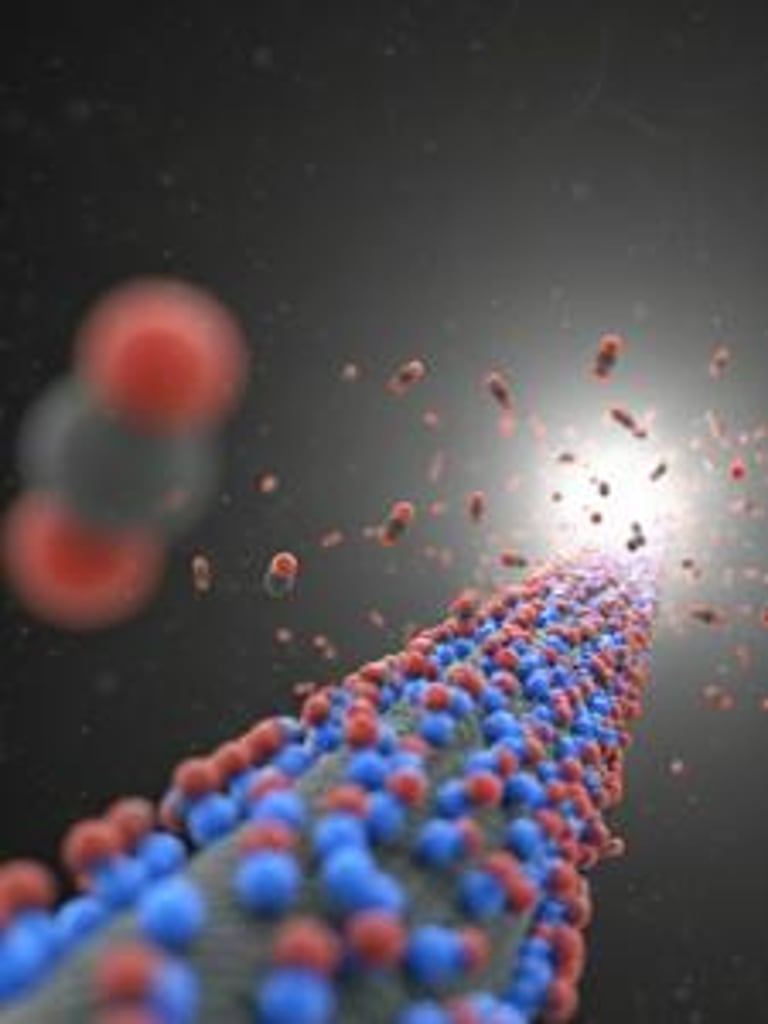

The exact placement of nitrogen near each other was confirmed through NMR, XPS, and computational modeling, establishing that these are non-random, side-by-side arrangements.
Viciazites are carbon materials engineered with neighboring nitrogen groups to optimize CO2 capture and overcome prior uncertainties from random nitrogen placement.
A key finding shows that when NH2 groups are adjacent, most adsorbed CO2 desorbs at temperatures below 60 °C, enabling potential use of industrial waste heat to reduce capture costs.
A Chiba University team, led by associate professors Yasuhiro Yamada and Tomonori Ohba, developed viciazites, a nitrogen-doped carbon material with adjacent nitrogen groups designed to boost CO2 capture efficiency.
Pyrrolic nitrogen, while needing higher desorption temperatures, may provide superior long-term chemical stability due to stronger bonds.
Thus, pyrrolic-nitrogen materials may trade lower energy release for enhanced durability over time.
Support and funding came from the Mukai Science and Technology Foundation, JSPS KAKENHI, and ARIM, underscoring a path toward cost-effective, scalable CO2 capture technologies.
Compared with aqueous amine scrubbing, solid nitrogen-doped carbons offer larger surface areas and lower-temperature desorption when nitrogen configurations are strategically arranged.
Beyond CO2 capture, viciazites could also remove metal ions or serve as catalysts thanks to their tunable surface properties.
Tests show that adjacent -NH2 groups or adjacent pyrrolic nitrogen markedly improve CO2 uptake compared with untreated carbon fibers, while adjacent pyridinic nitrogen shows limited benefit.
Desorption is favored at sub-60 °C for adjacent NH2 groups, while pyrrolic nitrogen requires higher temperatures but may offer greater long-term stability.
Overall, adjacent -NH2 configurations allow most CO2 to desorb under 60 °C, indicating potential for lower-energy desorption when paired with waste heat and lower operating costs.
Summary based on 3 sources
Get a daily email with more Science stories
Sources
EurekAlert! • Mar 26, 2026
Viciazites: Efficient carbon capture designer materials that could desorb below 60 oC
ScienceDaily • Mar 28, 2026
This new carbon material could make carbon capture far more affordable
SSBCrack News • Mar 28, 2026
New Carbon Material Offers Promising Breakthrough in Efficient CO2 Capture - SSBCrack News