China's 'Green Great Wall': Balancing Ecology and Economy in Desertification Battle
July 13, 2026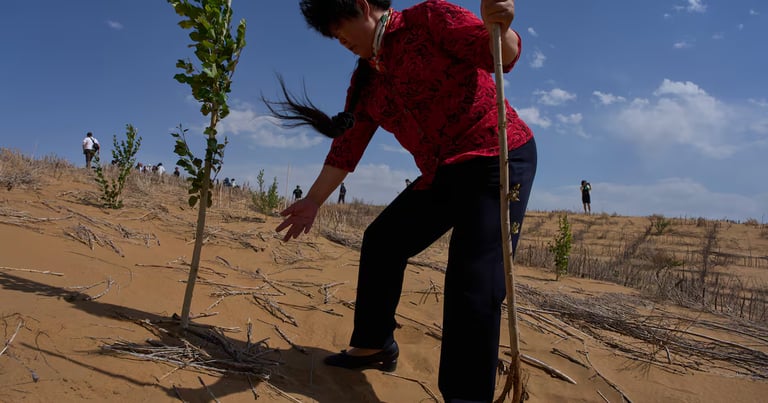


China’s Green Great Wall uses straw checkerboards and irrigation to stabilize dunes and expand vegetation across northern regions, delivering measurable ecological gains but requiring sustained effort.
Officials emphasize that the program’s scale and political commitment are critical, framing desertification reversal as a long-term development goal rather than a quick fix.
Experts say reversing desertification requires embedding conservation within long-term development plans and local economic support, not relying on large-scale tree planting alone.
China’s Green Great Wall blends ecological restoration with local livelihoods, emphasizing that environmental gains must go hand in hand with economic benefits to avoid a false trade-off between development and conservation.
Climate variability and rainfall have aided vegetation recovery in some areas, while frontline workers, scientists, and local communities—like Yin Yuzhen and her family—illustrate the social and economic dimensions of the effort.
The overarching goal is to halt desertification and foster self-sustaining ecosystems and communities through ongoing monitoring and adaptive management.
Looking ahead, the program’s continuation depends on ongoing funding, institutional backing, and engaging the younger generation to sustain land stewardship.
The program is framed in a global context, paralleling other desertification efforts such as Africa’s 2007 tree-planting initiatives, underscoring the need for continuous, community-driven strategies to sustain gains over decades.
While reversal is possible with long-term strategies, the biggest challenge is maintaining momentum and investment once interventions scale back.
Yin Yuzhen, a 60-year-old sand-control worker, recalls early loneliness but now works with family and volunteers to maintain checkerboard controls and trees, highlighting the social and livelihood dimensions.
The initiative has mobilized a vast labor force—hundreds of millions of rural workers—backed by top-down planning and substantial state investment.
Since 2000, desertified land has shrunk notably, with forest cover in the program area rising from about 5% in 1978 to 14% in 2022.
Summary based on 6 sources
Get a daily email with more World News stories
Sources
AP News • Jul 13, 2026
China fights spread of deserts with 'straw checkerboards' | AP News
Yahoo News • Jul 13, 2026
China’s 'Green Great Wall' tames desert growth, but scientists warn the fight is not over
ABC News • Jul 13, 2026
China’s 'Green Great Wall' tames desert growth, but scientists warn the fight is not over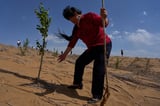
WDIV ClickOnDetroit • Jul 13, 2026
China’s 'Green Great Wall' tames desert growth, but scientists warn the fight is not over