Study Reveals Weakening of Key Atlantic Ocean Current, Signaling Climate Change Risks
September 23, 2026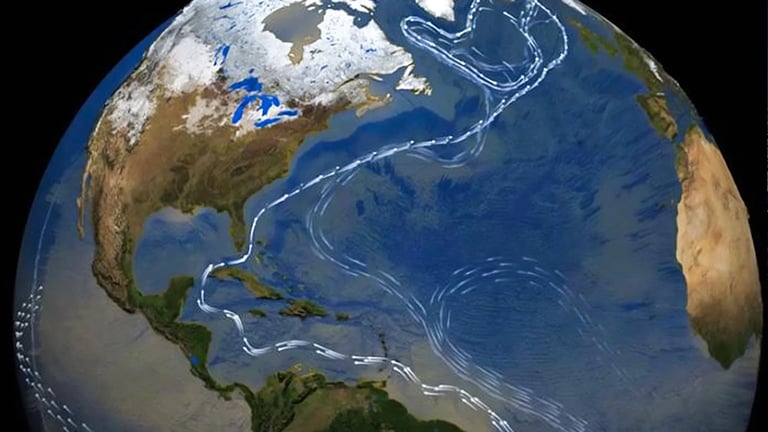

A new study finds the Atlantic Meridional Overturning Circulation (AMOC) weakening across a broad swath of the western North Atlantic over nearly two decades, signaling potential global climate implications.
The findings, published in Science Advances, were supported by grants from the U.S. National Science Foundation and the UK Natural Environment Research Council.
Researchers analyzed long-term bottom-pressure data from four ocean-monitoring arrays along the western Atlantic to assess deep-water movement and overturning strength using a consistent method across sites.
AMOC is described as a potential early warning signal for broader climate changes, with western Atlantic measurements acting like a canary in the coal mine for detecting long-term shifts.
Because AMOC transports heat northward, its weakening could influence European winters, rainfall patterns, hurricanes, sea levels, and overall coastal and regional climate.
The weakening extends from subtropical to mid-latitudes (about 16.5°N to 42.5°N), indicating a broad-scale shift rather than isolated fluctuations.
Summary based on 1 source
Get a daily email with more Science stories
Source

ScienceDaily • Sep 23, 2026
Scientists say a critical Atlantic Ocean current is weakening and the effects could be global