Study: Global Warming to Reach 1.5°C in 2029, With Some Regions Already Far Hotter
November 9, 2026


A study published in Nature Climate Change estimates that global warming will reach 1.5°C above preindustrial levels in 2029, while showing that regional warming varies sharply and some places have already warmed far beyond the global average.
To map that uneven warming, Consortium director Xuebin Zhang, lead author Tong Li and Francis Zwiers combined local weather observations, global temperature averages and climate-model simulations, comparing temperatures with the 1850–1900 baseline.
The team used a statistical method called Kriging for Climate Change to compare model simulations with observations and distinguish the effects of greenhouse gases and aerosols.
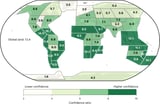
That approach helped estimate warming in regions with incomplete records, including parts of Africa, South America and the polar regions; tests across 45 simulations from 15 Earth-system models produced robust estimates for nearly all regions, with especially high confidence in the tropics.
By 2025, the Russian Arctic had warmed about 3.3°C, northeastern North America 2.6°C, and western and central Europe more than 2°C, while New Zealand had warmed just over 1°C; ocean-dominated areas including Southwest and South South America and Southeast Asia also saw comparatively little warming.
The study attributes practically all observed regional warming to human influence, with greenhouse gases as the dominant driver and aerosols partly offsetting that warming, particularly in industrialized regions of the Northern Hemisphere.
The researchers say regional conditions are already difficult to distinguish from those expected in a 1.5°C world, making adaptation urgent as world leaders gather for COP31 in Antalya, Türkiye.
Detailed regional estimates could help governments and communities plan for local impacts, including decisions about infrastructure such as buildings and bridges.
Xuebin Zhang said that hearing officials in Botswana describe the lack of local temperature data helped inspire the study, underscoring how regional information can help policymakers understand climate impacts.
The findings could also inform assessments of climate-related loss and damage, especially where historical records are limited, although the authors caution that their relatively small set of models may not capture the full range of climate responses.
Peter Stott called the method an important advance in showing how current warming compares with the Paris goals and how impacts differ by region, pointing to consequences such as heatwaves, floods and melting glaciers and ice sheets.
Francis Zwiers said limiting warming to 2°C remains possible but requires very rapid emissions cuts, while Xuebin Zhang stressed that sustained, high-quality climate observations are essential for tracking regional change and guiding adaptation.
Summary based on 11 sources
Get a daily email with more World News stories
Sources

Phys.org • Nov 9, 2026
Some regions may already be living in a 1.5°C warmer world

Telegraph India • Nov 10, 2026
Global warming nears 1.5°C levels across all regions, with 2025 readings at up to 94%, study says