Earth’s Ice and Snow Have Crossed a Proposed Safe Boundary, Raising Tipping-Point Risks
November 12, 2026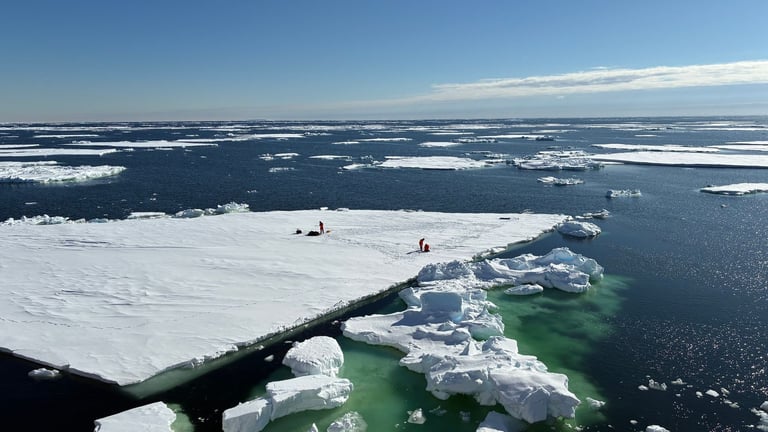

A study published in Science at COP31 concludes that Earth’s cryosphere—ice sheets, glaciers, sea ice, permafrost and snow cover—has moved beyond its proposed safe operating space, raising risks to Earth-system stability and the conditions human societies depend on.
The international team compared four indicators—land-ice volume, sea-ice area, snow cover and permafrost temperature—with variability during the Holocene, the 11,700-year period in which civilizations developed; the researchers describe their assessment as preliminary because data are incomplete and uncertainties remain substantial.
Sea ice and snow cover are already outside their historical ranges, with the areas lost equivalent to 7.8 and 6.8 times the size of California, respectively.
Permafrost indicators have also crossed the proposed limits: its area is estimated at 13.7 million square kilometres against a 14.8 million-square-kilometre threshold, and its average annual ground temperature is warmer than the minus 6.6-degree limit.
Land ice remains within its historical range for now, but its estimated safe threshold is 27.48 quadrillion tonnes compared with 27.63 quadrillion tonnes today, and at least 0.64 quadrillion tonnes of additional ice loss is considered unavoidable.
The research, led by scientists at Stockholm Resilience Center at Stockholm University and involving more than 30 scientists, identifies human-caused climate change as the main driver, alongside regional pressures such as black carbon emissions and industrial and infrastructure expansion.
Because the cryosphere helps regulate energy, water, carbon and methane cycles, its degradation heightens risks including warming, sea-level rise, ecosystem damage, floods and droughts, particularly for polar, mountain, coastal and low-lying communities.
The potential consequences are far-reaching: the West Antarctic Ice Sheet holds enough ice to raise sea levels by 11 feet, thawing permafrost could release carbon dioxide and methane, and melting Greenland ice could disrupt the ocean circulation that helps keep Europe temperate.
Crossing a proposed safe boundary does not mean the worst outcomes will happen immediately, but it increases the chance of dangerous Earth-system tipping points, especially as warming reaches and exceeds 1.5°C.
The authors urge policymakers to use the boundaries to set precautionary targets, cut greenhouse gas and black carbon emissions, reduce local disturbances and incorporate the cryosphere into the planetary boundaries framework.
Cutting fossil-fuel emissions is the most urgent way to protect ice and snow; proposed measures such as glacier blankets, pumping cold water to thicken ice or barriers around Antarctic glaciers may be costly and uncertain, and would not address the underlying cause of warming.
Co-author Lan Wang-Erlandsson said the cryosphere responds slowly to warming, meaning some future losses are already committed, but rapid emissions cuts can still slow the changes and action must begin now.
Summary based on 4 sources
Get a daily email with more Science stories
Sources
WIRED • Nov 12, 2026
Climate Change Has Pushed the World's Ice Out of Its Safe Zone
Gizmodo • Nov 12, 2026
Earth’s Ice Has Crossed an Alarming Threshold—and There May Be No Going Back