UK Names First Climate Security Envoy as Global Warming Threatens National Security
November 12, 2026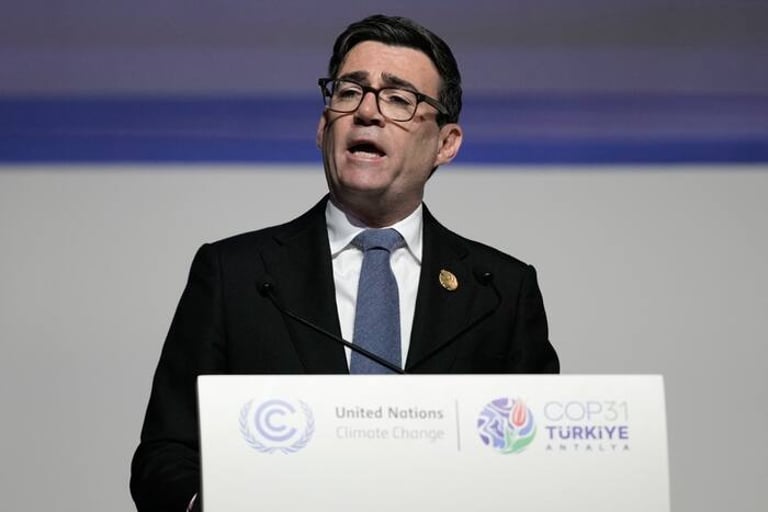


The United Kingdom has appointed Madeleine Alessandri as its first special representative for climate security, with Prime Minister Andy Burnham calling climate change an immediate national security threat and promising to make resilience a priority during Britain’s G20 presidency next year.
The appointment follows a Joint Intelligence Committee report developed under Alessandri’s leadership, which warned that ecosystem collapse overseas could threaten UK security within five years through food shortages, rising prices, mass migration and conflict.
Alessandri said climate change and nature loss are increasingly shaping the security environment, and governments should act early by strengthening understanding, resilience and preparedness.
Cosima Cassel of think-tank E3G called the role a major step toward embedding climate security in the national security system, while Greenpeace welcomed the initiative.
At COP31, the UK is backing a Turkish proposal to increase electricity’s share of global energy use from just over 20% to 35% by 2035, though critics say it lacks a clear plan to reduce fossil-fuel use; the United States was absent for a second year, and five other G7 countries sent no top leader.
The UK also plans to help raise £5 billion in private finance for clean-energy projects worldwide, while campaigners say domestic decisions—including approval of the Jackdaw gasfield, consideration of the Rosebank oilfield and possible weakening of electric-vehicle targets—undercut its climate leadership.
Critics also point to cuts in UK climate finance for poorer countries and a shift from donations to repayable loans; Prakash Dahal said Nepal needs grants, not loans, to adapt to climate impacts and recover from disasters.
A Climate Action Tracker report said global climate action has stalled for five consecutive years and projected that even if countries meet all current promises, the world would warm 2.6°C above preindustrial levels by century’s end, putting the Paris Agreement’s 1.5°C threshold at risk of irreversible overshoot.
At the summit, Brazil’s president, Luiz Inácio Lula da Silva, and UN chief Antonio Guterres urged governments not to let wars and trade disputes displace climate action, as the U.S. and Israeli war on Iran disrupted Middle East oil shipments and raised fuel prices; Saudi Arabia’s energy minister warned against climate measures that impede economic development.
Marshall Islands President Hilda Heine warned that continued fossil-fuel expansion threatens her country and described coral bleaching, while Barbados Prime Minister Mia Mottley urged wealthy nations to deliver climate finance, noting that pledges are not payments and promised funding had fallen well below previous levels.
Pakistani Prime Minister Shehbaz Sharif called for adequate financing for climate disasters, citing the 2022 floods that submerged more than a third of Pakistan, killed thousands and caused more than $30 billion in damage.
Seychelles Vice President Alix Sebastien Pillay said storms and floods are causing millions of dollars in damage despite Seychelles’ low emissions, and called for stronger support from the U.N. loss-and-damage fund without pushing vulnerable countries further into debt.
Summary based on 13 sources
Get a daily email with more World News stories
Sources
The Guardian • Nov 11, 2026
UK appoints world’s first special representative for climate security
U.S. News & World Report • Nov 12, 2026
UK Appoints Climate Security Envoy as Thunberg Criticizes COP31 Leaders
The Boston Globe • Nov 12, 2026
UK names climate security envoy as island leaders warn of ‘life-or-death’ crisis
Newsday • Nov 12, 2026
UK names a climate security envoy as island leaders warn of a 'life-or-death' crisis