Amazon Faces Another Devastating Fire Season as El Niño Intensifies Drought
November 15, 2026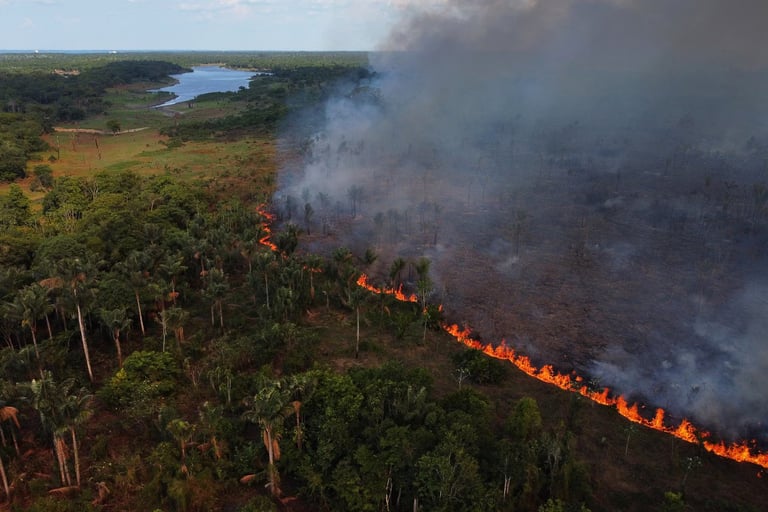


An intense El Niño is intensifying heat, drought and wildfires in the Brazilian Amazon, with United Nations forecasts indicating it could be the strongest in 70 years.
The forest is still reeling from the 2023–2024 El Niño, when rivers hit historic lows and fires burned about 15.8 million hectares; one study projected that more than half of the affected forest would not recover within seven years.
The fires are surging again: Brazil’s National Institute for Space Research recorded 2,271 hotspots in Amazonas state in October, 160 percent more than a year earlier, prompting scientists to warn that a severe fire season may be starting.
Smoke from fires around Manaus gave the city the world’s worst air quality on October 17, with fine-particle pollution nearly 30 times the World Health Organization’s daily limit; schools and universities suspended in-person classes, and officials urged residents to wear N95 masks.
Pará state and 50 municipalities in Amazonas state declared environmental emergencies to mobilize firefighting resources and assist about 161,000 affected families.
As rivers fall, riverbank communities that rely on waterways for transport are struggling to get around.
Joye Siqueira, a 35-year-old artisan near Manacapuru, says she now depends on small motorboats and needs three times as long to reach the nearest urban center to buy food.
El Niño typically reduces clouds and rainfall over northern South America, driving severe Amazon droughts; the forest is especially vulnerable because it has not recovered from recent damage and has been weakened by warming and deforestation.
Brazil has roughly halved deforestation since 2022, but researchers warn that cutting trees alone cannot protect forests made highly flammable by drought: fires kill trees, open the canopy, dry the forest floor and leave dead wood that can fuel future blazes.
With the world nearing 1.5°C of warming and roughly 17 percent of the Amazon already deforested, researcher Nico Wunderling warned that another tenth of a degree of warming and five percentage points of forest loss would push the rainforest into a high-risk zone.
The Amazon’s trees help generate and recycle rainfall, so forest loss can undermine the feedback system that sustains the rainforest; a computer-model study found an intact Amazon could withstand roughly 3.7–4°C of warming, but with 22–28 percent deforestation, just 1.5–1.9°C could trigger near-basin-wide collapse.
Many forests burning now have already burned during previous El Niño droughts, and each severe fire season makes later fires more likely and damaging; researchers are particularly concerned about the 2027 dry season, after the projected El Niño peak and seasonal drought.
Summary based on 2 sources
Get a daily email with more World News stories
Sources
Scientific American • Nov 16, 2026
Can the Amazon rainforest survive the largest El Niño in living memory?