Bitcoin's New Quantum Defense: BIP-361 Proposal to Safeguard 1.7 Million BTC from Quantum Threats
April 19, 2026

The story centers on BIP 361, a Post Quantum Migration and Legacy Signature Sunset plan for Bitcoin that aims to migrate legacy signatures and potentially freeze unmigrated coins to address quantum threats.
Bitcoin developers introduced BIP-361, titled Post Quantum Migration and Legacy Signature Sunset, with publication and editor pin in mid-April 2026.
External pressure from looming quantum breakthroughs (2027–2030 window) and high-profile efforts like Google's migration timeline add urgency for Bitcoin to consider a post-quantum upgrade.
The context includes warnings about quantum risk to ECC, noting timelines and devices like Willow’s 105-qubit processor suggesting quantum breaks could come in the coming years.
BIP-361 builds on BIP-360’s pay-to-Merkle-root outputs, which protected newly created coins but left about a third of the supply exposed to quantum risks.
Estimates warn that roughly 34% of Bitcoin supply—about 1.7 million BTC in legacy formats and additional early-era mined coins—could be vulnerable in a quantum era.
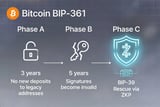
The proposal outlines a three-phase upgrade: first, block legacy P2PK addresses from receiving funds; second, invalidate ECDSA/Schnorr spends on unmigrated UTXOs; third, implement a zero-knowledge recovery path to migrate remaining coins.
Phase C envisions a rescue mechanism using zero-knowledge proofs tied to BIP-39 seeds to allow legitimate owners to reclaim coins to post-quantum addresses, though development is ongoing.
Phase A, three years after activation, would stop new deposits to legacy vulnerable addresses while still allowing spending from them.
Phase B, five years after activation, would fully invalidate ECDSA and Schnorr signatures on legacy outputs, effectively freezing those coins.
The plan emphasizes a three-phase sunset approach to retire legacy, quantum-vulnerable outputs after activation.
As of April 17, 2026, BIP-361 remains a draft with no activation parameters or signaling mechanism, with future discussions expected at conferences and on the bitcoin-dev mailing list.
Summary based on 2 sources