AI Audits Expose Crypto & Banking Software Flaws, Urging Formal Verification Amid Market Volatility
June 6, 2026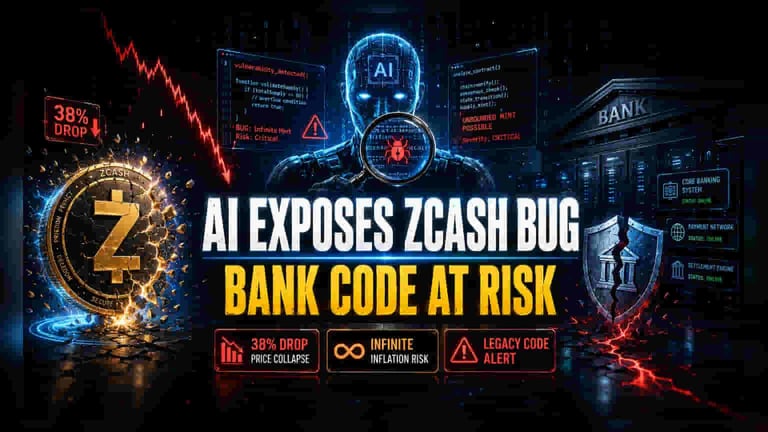


Banks face a real-world trade-off between maintaining legacy compatibility and pursuing architectural overhauls necessary for formally verified code, creating a vulnerability window in current operations.
Traditional banking's inertia and reliance on third-party software extend patch delays, widening vulnerability windows across interconnected financial ecosystems.
Industry proponents, including Haseeb Qureshi, view AI-assisted vulnerability discovery as beneficial and see AI helping implement fixes through formal verification, even as deployment remains limited.
AI-driven auditing and vulnerability discovery are likely to reveal widespread weaknesses across both decentralized crypto networks and traditional banking software as systems age and accumulate complex codebases.
Formal verification—mathematically proving software correctness—emerges as an urgent operational necessity to prevent systemic contagion in financial infrastructure, moving from manual checks toward rigorous proofs.
Rust’s use in Zcash complicates formal verification due to unsafe libraries and performance trade-offs, though approaches like supercompilation may help mitigate speed concerns.
The disclosure of a critical flaw caused market stress, with Zcash’s token price plunging roughly 38% in a single session, underscoring the financial impact of undiscovered software flaws.
If left undisclosed, the bug could have allowed unlimited counterfeit token creation, amplifying the potential damage and volatility in crypto markets.
Security firms warn of AI-enabled offensives concentrating power and capabilities, pressuring institutions to adopt rigorous, proof-based security as legacy systems lag behind.
There is an asymmetric security battle: attackers can marshal massive AI-assisted resources to target contracts, while defenders must weave automated scanners and mathematical proofs into development pipelines.
Industry voices argue that integrating mathematical proofs into development is essential, even as firms confront practical constraints in legacy environments.
Thought leaders in the crypto space contend that formal verification could become essential for security, though adoption is slowed by developers’ reluctance to rewrite and verify deeply nested code.
Summary based on 3 sources
Get a daily email with more AI stories
Sources

Crypto Economy • Jun 5, 2026
Experts Warn Banks Could Be Next After AI Exposes Long-Hidden Crypto Vulnerability - Crypto Economy
Whalesbook • Jun 5, 2026
AI-Driven Crypto Hack Exposes Deep Flaws in Banking Software