AstralBeam Launches on Casper to Revolutionize Cross-Chain Tokenized Asset Transfers with Compliance Focus
September 8, 2026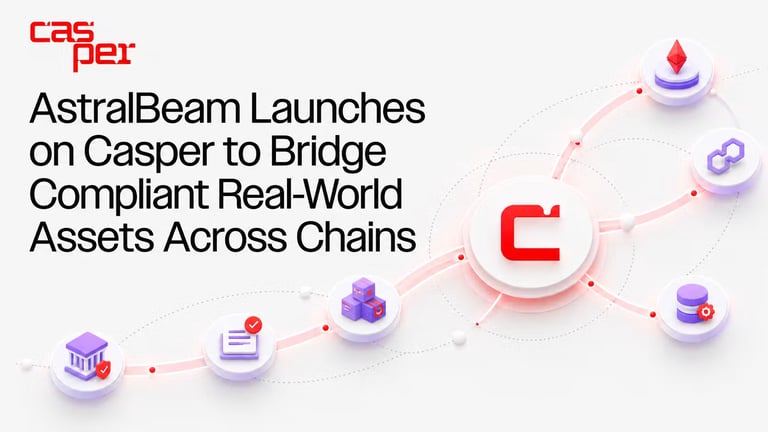


AstralBeam, a cross-chain bridge built by MAKE Group, launches on Casper to move tokenized real-world assets across Casper, Robinhood Chain, Base, Ethereum and Polygon while carrying compliance state via the ERC-7786 standard and T-REX Ledger.
Three key upcoming milestones will determine success: the T-REX mainnet launch, Casper DeFi’s development of collateral markets and RWA vaults, and the pace of Apex’s pledged asset flow driving regulated volume across connected chains.
The system enables transfer eligibility checks against a shared compliance record before settlement, addressing the problem of compliance rules not traveling with tokens across chains.
The public testnet launches today with mainnet planned later; the T-REX Ledger, a sovereign chain for maintaining a reference copy of who may own what and under what conditions, is central to the architecture and mainnet is expected in Q4 2026.
Apex Group plans to bring $100 billion in tokenized assets to T-REX by June 2027, illustrating expected scale and the need for multi-chain liquidity across regulated assets.
Robinhood Chain is identified as a critical connector due to its active 24/7 tokenized stocks trading and wide coverage, illustrating the importance of bridging to non-EVM ecosystems with maintained compliance.
AstralBeam emphasizes a five-verifier, three-of-five consensus model to mitigate bridge risk, outperforming prior two-of-five or five-of-nine schemes, and notes ongoing six-month testnet operation plus a Halborn audit with full report forthcoming.
Apex Group's Tokeny, Polygon Labs, and the ERC-3643 Association launched the T-REX Ledger in March 2026, connecting chains via Agglayer to maintain cross-chain compliance state for ERC-3643 tokens.
Casper is highlighted for its upgradeable smart contracts, native ERC-3643 support, and faster finality, making it a suitable non-EVM partner that can host regulated tokens while maintaining cross-chain connectivity.
Summary based on 1 source