France Leads Charge to Block EU-Mercosur Trade Deal Amid Farmer Protests
December 19, 2024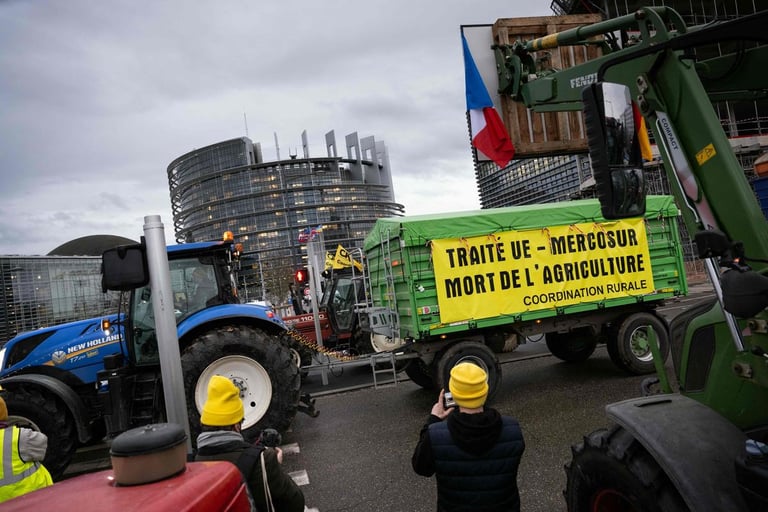


A significant trade agreement between the EU and Mercosur countries, including Argentina, Brazil, Paraguay, and Uruguay, was signed in December 2024, impacting nearly 800 million people.
France plans to block the deal over concerns it will harm its farming sector, requiring support from at least three other EU countries representing 35% of the population to do so.
To successfully block the agreement, France may seek support from nations like Ireland, Poland, Austria, and potentially Italy, whose stance remains uncertain.
French farmers have been actively protesting the deal, with demonstrations highlighting their concerns about its impact on local agriculture and jobs.
On December 19, 2024, farmers protested outside the European Parliament in Strasbourg, demanding food sovereignty and local production.
The demonstration featured around twenty tractors displaying messages such as 'Don't poison our children with your imported products' and 'EU-Mercosur treaty, death of agriculture.'
French farmer Alix Heurtault expressed fears that the deal will worsen economic conditions for farmers like her, who grow sugar beet, wheat, and barley.
Stéphane Gallais, a cattle farmer and union leader, criticized the deal as detrimental to European farmers, particularly due to the competitive advantages enjoyed by Mercosur producers.
Critics, including Paul Fritsch, highlighted the stark differences in social wages, health regulations, and environmental norms between the EU and Mercosur countries.
While some EU nations support the deal as a counter to global protectionism, critics argue it poses significant risks to European agriculture.
The trade agreement is expected to increase imports of South American beef, chicken, and sugar into the EU, while allowing EU exports like cars, clothing, and wine greater access to Mercosur markets.
The agreement aims to reduce tariffs and increase import/export limits, contrasting with the anticipated return to protectionism under Donald Trump.
Summary based on 2 sources