French Astronaut Sophie Adenot to Lead Pioneering ISS Mission with Educational Focus
November 25, 2025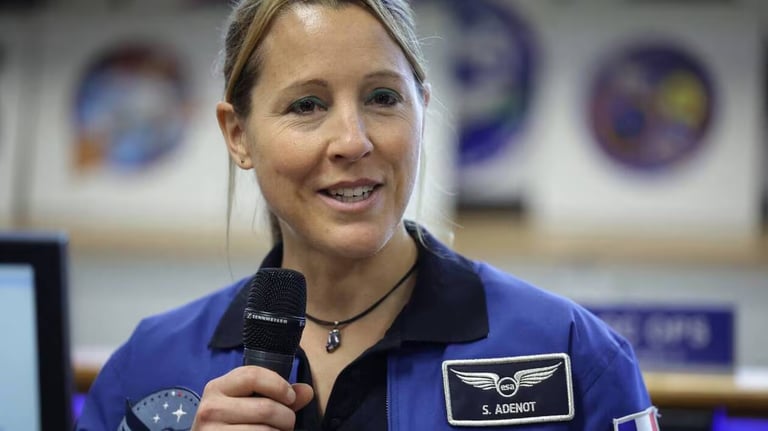

She also details the ascent, orbital operations, spacewalks, robotic arm work, and the thermal dynamics of re-entry as part of the mission profile.
French astronaut Sophie Adenot is preparing for an eight-month mission to the International Space Station set to launch in February 2026, making her the second French woman in space after Claudie Haigneré.
At 43, Adenot will train extensively with simulations and emergency scenarios to stay calm under pressure, citing Haigneré as a major inspiration and pivotal moment in her career.
Before departure, she will bring a large box of seeds—Arabidopsis thaliana and mizuna—to study plant germination and growth under microgravity and varying light exposure.
Adenot will photograph the plant growth aboard the ISS at intervals and share the images with about 260,000 students participating in the ChlorISS educational project, who will grow the plants in their classrooms.
Her mission includes CNES-developed experiments on physiological data collection, cognitive testing, autonomous ultrasound procedures, and a prototype intravehicular suit developed with Decathlon and Spartan Space.
Adenot describes the launch sequence and orbital operations, noting a 70-meter rocket, speeds reaching orbital velocity, and the ISS’s 28,000 km/h orbit, along with on-board activities like spacewalks and robotic arm maneuvers.
Adenot emphasizes rigorous training and emergency preparedness, including procedures for depressurization, fires, and plumbing leaks to stay calm during missions.
The seeds are part of seven French science experiments designed and developed at CNES in Toulouse, informing ChlorISS activities for the ESA mission.
Cadmos experiments will advance medical procedures, cognitive testing, autonomous ultrasound, and data collection for long-term exploration, with some experiments performed independently by astronauts.
Preflight medical data collection will study microgravity effects on the body, with Cadmos and other experiments focusing on physiological data, cognitive tests, autonomous ultrasound, bio-contamination analysis, and plant growth for educational outreach involving about 260,000 French students.
Adenot is training at NASA’s Johnson Space Center in Houston alongside the Artemis II crew, highlighting the broader context of ongoing human spaceflight activities and signaling a historical moment in current exploration.
Summary based on 4 sources