Tensions Rise in Arctic as NATO and Russia Conduct Overlapping Military Drills
March 16, 2026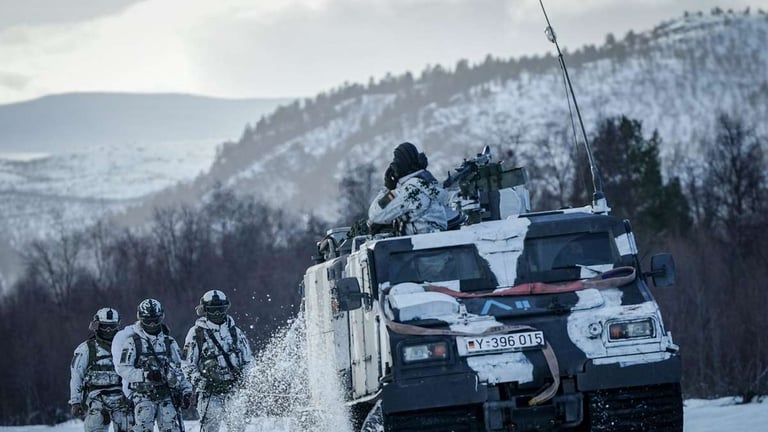

Germany’s participation underscores NATO’s commitment to deterrence in the High North, including a scenario that envisions counterattacks to recover lost allied territory amid Arctic conditions.
Analysts view Moscow’s moves as a strategic signal and deterrence demonstration focused on the Kola Peninsula, with implications for regional power projection and NATO readiness.
Analysts note a shift away from reciprocal exercises and increased uncertainty in regional postures, with concerns centering on the Nordflotte’s capabilities for NATO deterrence.
Russia’s Northern Fleet announces a Barents Sea missile exercise from March 11 to 13, overlapping with NATO drills and signaling across the Norway–Russia sea border.
The Barents Sea missile drills are planned during the NATO exercise window, with details on missiles not specified.
NATO conducts the long-planned Cold Response 2026 Arctic exercise, involving about 25,000 troops from multiple nations, to defend the European Arctic and test civilian support capabilities.
Germany contributes roughly 1,600 personnel across the Army, Air Force, and Navy, including Mountain Infantry Brigade 23, to counterattack and retake alliance territory under Arctic conditions.
Officials stress the overarching goal of alliance defense and deterrence, using collaborative exercises to strengthen readiness amid evolving Arctic security dynamics.
Norwegian defense officials and global experts describe a tense Arctic environment where transparency is down and posturing is up, raising the stakes for alliance deterrence.
NATO and Russian Arctic activity is drawing scrutiny from Norwegian and international outlets, with officials warning that signaling and escalation could rise as both sides posture in the High North.
The Cold Response 2026 exercise runs from early March through March 19, emphasizing alliance defense and interoperability in Arctic environments.
Norwegian authorities highlight the Kola Peninsula’s nuclear arsenal, submarines, and newer Russian assets as central to regional risk in northern Europe.
Summary based on 2 sources