Euclid Telescope Unveils Oldest Known Quasars, Illuminating Early Universe Mysteries
July 6, 2026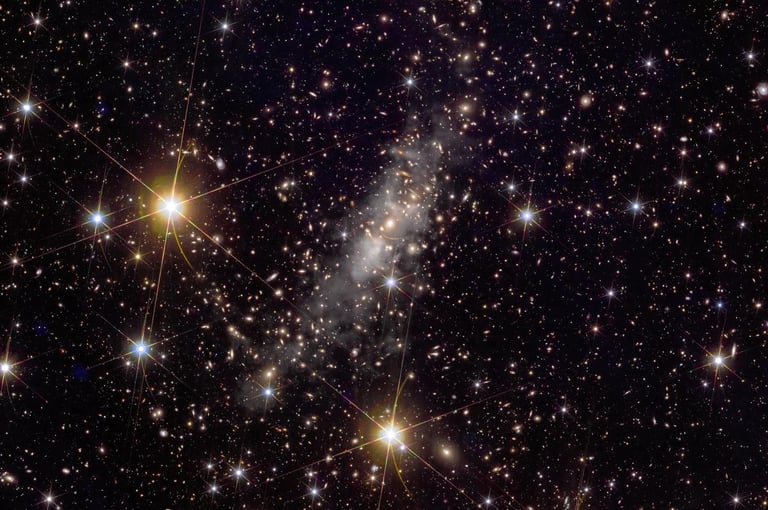


ESA officials and scientists highlight Euclid’s unique combination of wide sky coverage, depth, sharp imaging, and infrared capabilities, enabling efficient sampling of rare, distant objects.
The findings underscore Euclid’s role in advancing quasar science through its wide-area coverage, depth, resolution, and infrared data, with processing supported by the Euclid Consortium.
While these observations push knowledge forward, they also deepen the mystery of how such massive black holes formed so rapidly in the early universe.
Euclid, launched in 2023 and commencing routine science in early 2024, is an international collaboration spanning Europe, the USA, Canada, and Japan, involving agencies including ESA and NASA.
Beyond this, Euclid’s broader mission maps one-third of the sky to probe dark matter and dark energy, with high-resolution images of the Milky Way and distant structures already released.
Launched in mid-2023, Euclid carries a high-resolution telescope with visible and near-infrared cameras to map galaxy motions and shapes across ten billion years of cosmic history.
New measurements from the NOEMA array show the galaxy hosting the second-placed quasar forms more than 250 solar masses of stars per year, signaling rapid ongoing growth.
Future work aims to find even older quasars to refine the timeline of the early universe and sharpen theoretical models.
Researchers note that the newly found galaxies around these quasars show the ingredients needed to become large, mature galaxies, indicating substantial growth remains ahead for these systems.
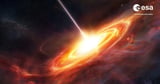
The European Space Agency’s Euclid space telescope has identified 31 quasars from the early universe, including the two oldest known quasars with redshifts 7.77 and 7.69, dating to roughly 670 million years after the Big Bang.
Quasars are among the most luminous galactic centers powered by accreting supermassive black holes, and their light helps illuminate how early galaxies and black holes formed and grew.
The discovery contributes to understanding how the first supermassive black holes and galaxies formed and evolved during the universe’s infancy, especially during the epoch of reionization.
Summary based on 8 sources
Get a daily email with more World News stories
Sources
Yahoo News • Jul 6, 2026
Oldest quasars ever discovered add to 'perplexing' space mystery
Phys.org • Jul 6, 2026
Euclid discovers the most ancient quasars in the universe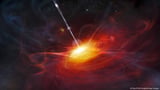
Deutsche Welle • Jul 6, 2026
European space telescope Euclid spots oldest quasars yet