French Mathematician Frank Merle Wins $3M Breakthrough Prize for Groundbreaking Work on Nonlinear Equations
April 21, 2026


His work probes the theoretical limits of evolution models and their reliability, with potential implications for engineering, aerospace safety, and astrophysics where extreme conditions test predictive power.
Merle has built a recognized school of thought in mathematical analysis through his influential work.
Merle stresses that fundamental research is the long-term bedrock of future innovations and deserves steady, regular support amid public discourse that often overlooks this in many countries.
Le Monde’s article on Merle is subscription-based, with portions reserved for subscribers.
His research linked nonlinear PDEs to fluid dynamics, addressing singularities in the compressible Euler and Navier–Stokes equations and challenging prior beliefs about stability.
Merle, who holds the Analysis Chair at CY Cergy Paris Université–IHES, was honored in Los Angeles for major advances in nonlinear evolution equations, with a focus on stability, singularities, and solitons.
Merle reflects on his career path, advocating for borderless science and collaboration with institutions in France and the United States, and committing to humanity at large.
A French mathematician, Frank Merle, won the 2026 Breakthrough Prize in Mathematics, earning a $3 million cash award for groundbreaking work on nonlinear evolution equations and demonstrating that certain systems long thought stable can blow up to infinity.
Among his contributions is clarifying singularity formation in KdV-type equations, linking mathematical results to physical phenomena from shallow water to rogue waves.
The Breakthrough Prize Foundation announced the 2026 results, highlighting Merle’s achievements, including a complete classification of blow-up behaviors for the nonlinear Schrödinger equation and finite-time blow-up for its defocusing variant.
He emphasizes that solvable reductions emerge from chaotic, infinite-parameter systems, yielding tractable descriptions with a finite parameter set.
Central to his work is the role of solitons as stable, energy-rich wave solutions and the idea that complex nonlinear dynamics can be understood through soliton interactions, connecting to the soliton resolution conjecture.
Summary based on 5 sources
Get a daily email with more World News stories
Sources

VnExpress International • Apr 21, 2026
French mathematician Frank Merle wins $3M math prize dubbed 'Oscars of Science'
VnExpress International • Apr 21, 2026
French mathematician Frank Merle wins $3M prize dubbed 'Oscars of Science'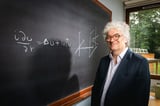
Scientific American • Apr 19, 2026
Master of chaos wins $3M math prize for ‘blowing up’ equations