Fragile Ice on Europa and Enceladus Poses Risk for Lander Missions, Study Reveals
May 15, 2026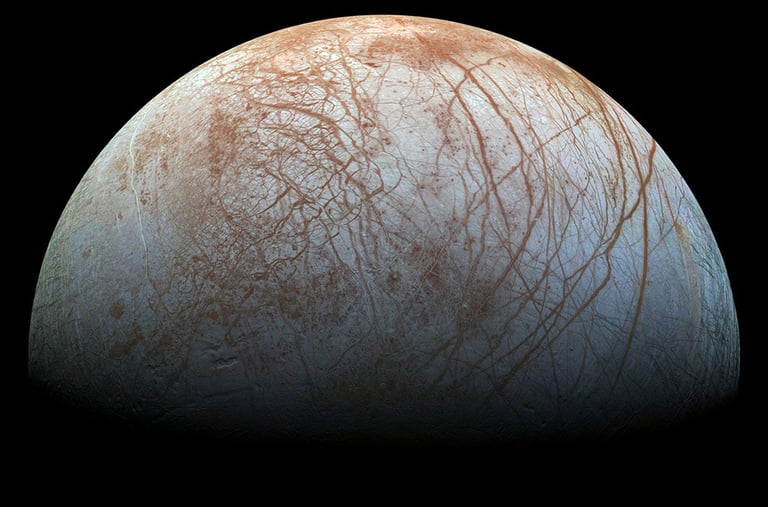


The findings have practical implications for upcoming missions to Europa and Enceladus, indicating that landing mechanisms must account for extremely porous, fragile subsurface ice that could endanger traditional lander designs.
A new study identifies a porous, fluffy ice layer forming under low-pressure freezing and cryovolcanic processes on these ocean moons, presenting a potential hazard for landers.
This fragile layered ice could cause landers to crash through the surface or become unstable at touchdown, creating serious safety concerns for future missions.
In a large vacuum chamber, researchers cooled 49 kilograms of low-salinity water to replicate outer Solar System conditions, witnessing a three-stage freezing process that yields a croissant-like fluffy ice structure.
The experiment showed initial boiling and crust formation, followed by vapor-pocket freezing, and the development of a bottom, more transparent ice layer, resulting in a stack of brittle, layered ice.
Lead researcher Vojtěch Patočka notes vapor escape drives low-pressure freezing, implying that the fragile layers on smaller icy worlds could be several meters thick.
Vacuum chamber tests indicate water on Europa and Enceladus can form fluffy, highly porous ice sheets, potentially several meters thick on Europa and up to 20 meters on Enceladus.
Researchers describe the ice as having a phyllo-cellular, wasp-nest-like structure, highlighting its extreme fragility and ease of penetration.
The study, published in Earth and Planetary Science Letters and presented at the European Geosciences Union General Assembly, underscores unanticipated engineering challenges posed by fluffy ice for ocean-world missions.
Future work includes repeating experiments with flowing water to better simulate cryovolcanic flows and refine understanding of porous ice formation to inform safer lander designs.
Under low-gravity conditions, the experiments show water can crystallize into brittle, highly porous sheets that may be several meters to hundreds of meters thick, posing a risk of sinking or landing failure for probe landers.
Europa and Enceladus remain high-interest targets due to suspected subsurface oceans and active cryovolcanism, with missions like Europa Clipper and JUICE planned for the 2030s.
Summary based on 2 sources
Get a daily email with more Tech stories
Sources
Gizmodo • May 15, 2026
Missions to Ocean Moons Face a Strange Hazard Scientists Didn’t Expect
AAAS logo • May 13, 2026
Fluffy ice could imperil spacecraft landings on ocean moons