Switzerland's 88-Foot Deep Battery to Revolutionize Renewable Energy Storage and Grid Stability
June 6, 2026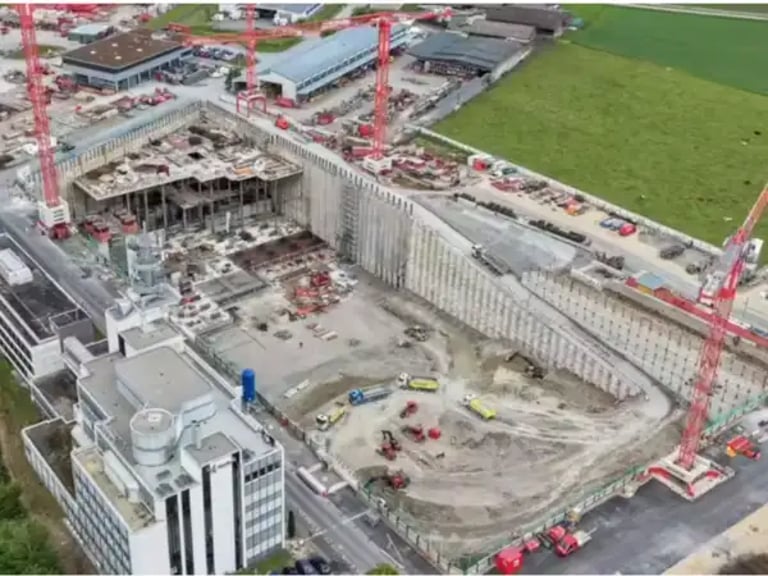

FlexBase and partners are building one of the world’s most powerful batteries in an 88‑foot‑deep underground pit near Laufenburg, Switzerland, to store excess renewable energy and stabilize the grid.
The project in Switzerland uses vanadium redox flow technology for a large underground energy storage facility, with completion targeted for 2029 and backed by FlexBase and Invinity Energy Systems.
The initiative sits within a broader effort to address renewable energy timing mismatches, smoothing solar and wind generation with demand.
The storage site is tied to a planned 500 MW AI data center complex that would benefit from stable electricity to smooth demand and reduce fossil backup power.
Targeted capacity is about 2.1 GWh, enough to power roughly 200 U.S. homes for a year and to respond quickly to grid fluctuations.
The project aims to reduce grid pressure, lower fossil fuel backup reliance, and improve cross‑border energy sharing in Europe through more reliable renewables.
By rapidly releasing stored energy, the installation seeks to boost grid stability and address mismatches between renewable generation and consumption.
Redox flow batteries, including vanadium types, are scalable by increasing tank size, tolerate frequent cycling, and are safer due to non‑flammable electrolytes, though they are large and best suited for stationary storage.
Flow batteries offer safety advantages for large underground installations because of lower thermal risk.
The battery build‑out will form part of a large interconnected complex at the Star of Laufenburg transmission hub, a historic cross‑border grid linking Germany, France, and Switzerland.
The site near the Star of Laufenburg substation enables regional grid support across three countries.
Beyond storage, the project is designed to support digital infrastructure and AI data centers’s growing power demands.
Summary based on 2 sources
Get a daily email with more Tech stories
Sources

Economic Times • Jun 6, 2026
Inside Switzerland’s massive underground flow battery that could power 210,000 homes for a day without lit