Mac OS X Cheetah Successfully Ported to Nintendo Wii: A Technical Feat
April 9, 2026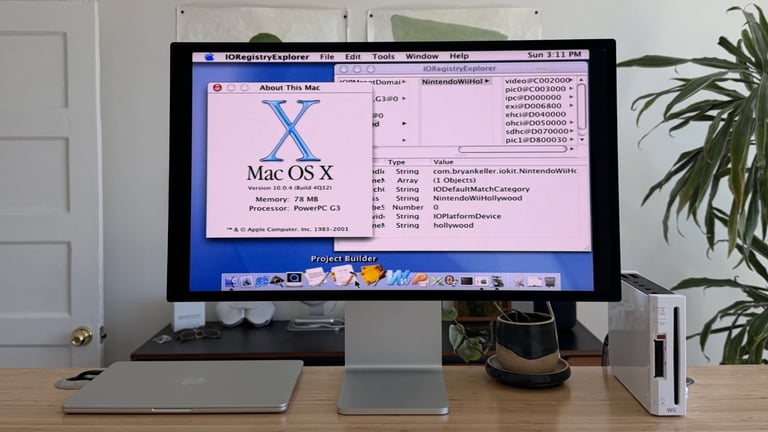


A custom bootloader was written to initialize the Wii hardware, load the kernel from an SD card, and build a dedicated device tree, enabling the port of Mac OS X 10.0 Cheetah to the Wii.
The port required a multi-step approach: patching the XNU kernel to recognize Wii hardware, developing drivers for Wii components, and creating a Wii-specific device tree and boot process modeled after traditional Mac sequences like Open Firmware and BootX.
SD card handling centered on uncached memory buffers to maintain data coherence between ARM MINI and PowerPC, with IPC_SDMMC_SIZE/READ/WRITE commands used for capability checks and data transfer.
A framebuffer driver was built, locating framebuffer memory at 0x01700000 with a 640x480, 16-bit color setup, enabling full GUI output as the system transitioned from a basic framebuffer to a complete GUI.
The project underlines a broader lesson: pursuing seemingly unreachable goals can drive significant personal and technical growth, validating the decision to tackle the challenge.
Feasibility was assessed by comparing Wii hardware to early PowerPC Macs, noting the Wii’s 88 MB RAM and a workable 64 MB subset, with validation via a QEMU boot of 64 MB RAM for Cheetah.
Mac OS X 10.0 Cheetah was selected for its low RAM requirements and PowerPC compatibility, aligning with the Wii’s memory constraints.
The Wii’s hardware differences, including the PowerPC 750CL CPU and limited memory, were analyzed to determine whether a macOS port could be viable.
IOBlockStorageDriver introduced IOMedia nubs representing SD card partitions to enable root filesystem discovery and move past the initial boot hurdle of waiting for the root device.
Driver development followed the IOKit model, creating representations for the Hollywood SoC and device nubs to attach SD cards, framebuffer, and other components.
A suite of drivers—Hollywood SoC, SD Card, and framebuffer—plus a mouse/keyboard patch obtained through collaboration, were developed to enable macOS operation on the Wii.
The project culminated in successfully running a flavor of Mac OS X Cheetah on Nintendo Wii hardware, marking a notable hardware-software integration achievement.
Summary based on 3 sources
Get a daily email with more Startups stories
Sources
AppleInsider • Apr 9, 2026
Nintendo Wii can run Mac OS X like it's 2001 all over again
Bryan Keller’s Dev Blog • Apr 8, 2026
Porting Mac OS X to the Nintendo Wii