Wyoming 'Mummy Zone' Reveals Stunningly Preserved Edmontosaurus Specimens, Offering New Insights into Dinosaur Anatomy
November 30, 2025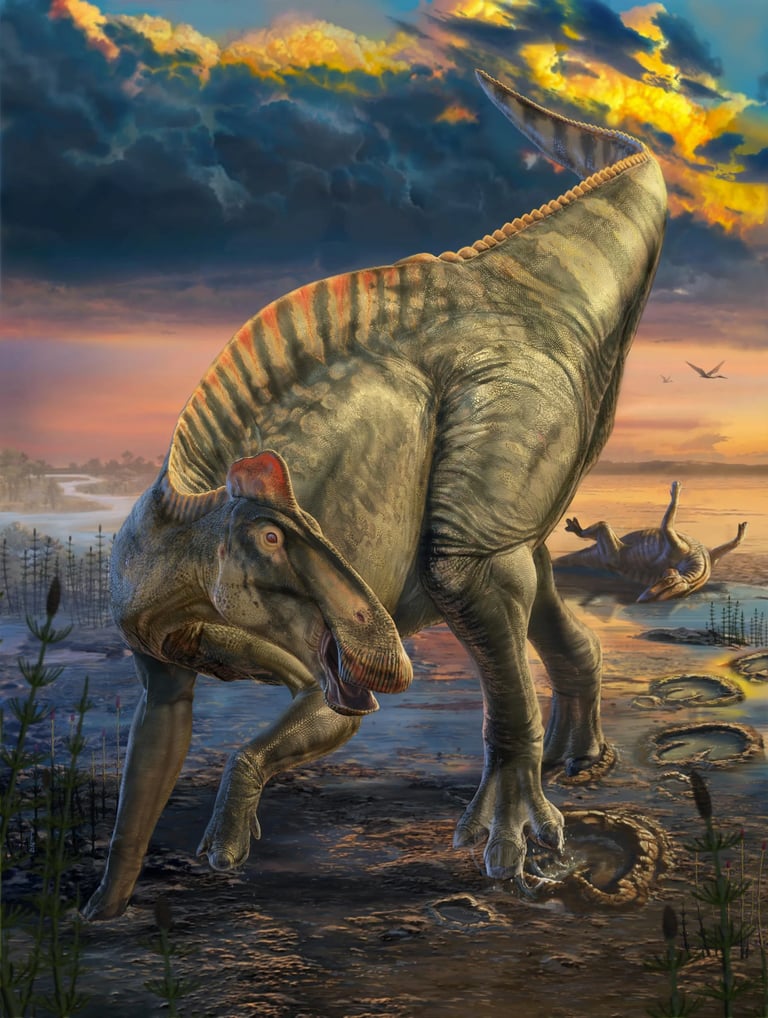

Advanced imaging and 3D reconstructions were employed to recreate a living posture and gait, aligning the model with fossil footprints for validation.
Field work in east-central Wyoming uncovered a historic “mummy zone” where two Edmontosaurus specimens—a late juvenile and a young adult—preserve extensive external skin.
Two newly described mummies reveal continuous patches of external skin, a fleshy neck crest, a row of tail spikes, and hooves enclosing the hind-toe tips, offering the first well-supported fleshed-out view of a large dinosaur.
The study provides a practical framework for dinosaur soft-tissue research, including standardized terminology, imaging pathways, and a clay-templated mummification model to guide future discoveries.
Scientists propose a formation sequence where sun-dried carcasses are rapidly buried by flash floods, followed by a microbial film that templated clay particles, the decay of soft tissues, and eventual fossilization.
Additionally, the work offers a toolkit for future research with new preparation methods, standardized terminology for soft structures, an imaging workflow from fossil to flesh model, and a template for field-based dinosaur mummies.
Key anatomy includes a continuous midline crest over the neck and back, a single row of tail spikes, predominance of small 1–4 mm scales, and three-toed hind hooves with a fleshy heel pad.
Researchers used hospital and micro-CT scans, X-ray spectroscopy, thin-section microscopy, and clay composition tests to analyze preservation and reconstruct the dinosaur in life with input from digital artists.
The team cleaned, scanned, and digitally rebuilt the dinosaur, producing lifelike reconstructions aided by digital artists.
Sereno notes this work as a landmark in visualizing a large dinosaur’s appearance and provides a practical model for clay-templating preservation and external anatomy for future paleontological work.
He also highlights the potential for locating more Wyoming specimens and applying the model to other regions and fossils in future research.
The preservation features a micro-thin clay coating that captured the exterior silhouette after burial, with soft tissues decaying and leaving behind a clay mask over the skeleton.
Summary based on 2 sources
Get a daily email with more Science stories
Sources

ScienceDaily • Nov 30, 2025
Dinosaur mummy found with hooves and a hidden crest
SciTechDaily • Nov 20, 2025
The First Hooved Reptile: Dinosaur “Mummies” Reveal a Shocking Evolutionary Twist