Study Reveals Sauropods' Surprising Ability to Stand on Two Legs for Feeding, Mating, and Defense
January 17, 2026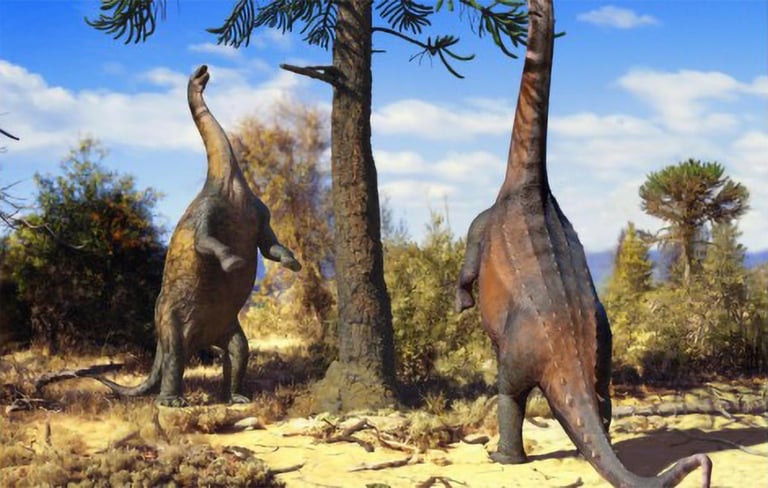

Researchers built digital femur models from seven sauropod species and used finite element analysis to assess how gravity and muscle forces stress the thigh bone when these giants stood on two legs.
The results suggest that a bipedal stance could have offered advantages for reaching high foliage, displaying mating signals, and deterring predators, though the findings are best read as comparative insights rather than exact biomechanical reconstructions.
Larger sauropods could stand only for shorter periods due to increased femoral stress and the overall discomfort of the posture, with adults facing greater challenges than juveniles.
The authors caution that while the method is robust for comparisons, it omits certain elements like cartilage, which could slightly alter the stress outcomes.
The study was published in Palaeontology on August 1, 2025, with funding from FAPESP and CNPq, and involved researchers from Brazil, Germany, and Argentina.
Computational engineering indicates that long-necked, four-legged sauropods could stay upright on their hind legs for extended periods, aiding feeding, mating, and defense.
Digital reconstructions relied on fossil specimens from global museum collections, and the researchers acknowledged limitations, including missing cartilage and tail support in the models.
Juvenile Uberabatitan ribeiroi and Neuquensaurus australis showed the lowest femoral stress in bipedal postures, suggesting these species could maintain upright stances more readily than larger adults.
The analysis distinguished extrinsic forces (gravity and body weight) from intrinsic, muscle-driven forces to estimate stress patterns on the femur during bipedal stance.
Summary based on 1 source
Get a daily email with more Science stories
Source
SciTechDaily • Jan 17, 2026
These Giant Long-Necked Dinosaurs Could Stand Upright – and Scientists Finally Figured Out Why