DHRS7 Enzyme: Key Player in Wound Detection, Oxidative Stress, and Innate Immunity
October 7, 2026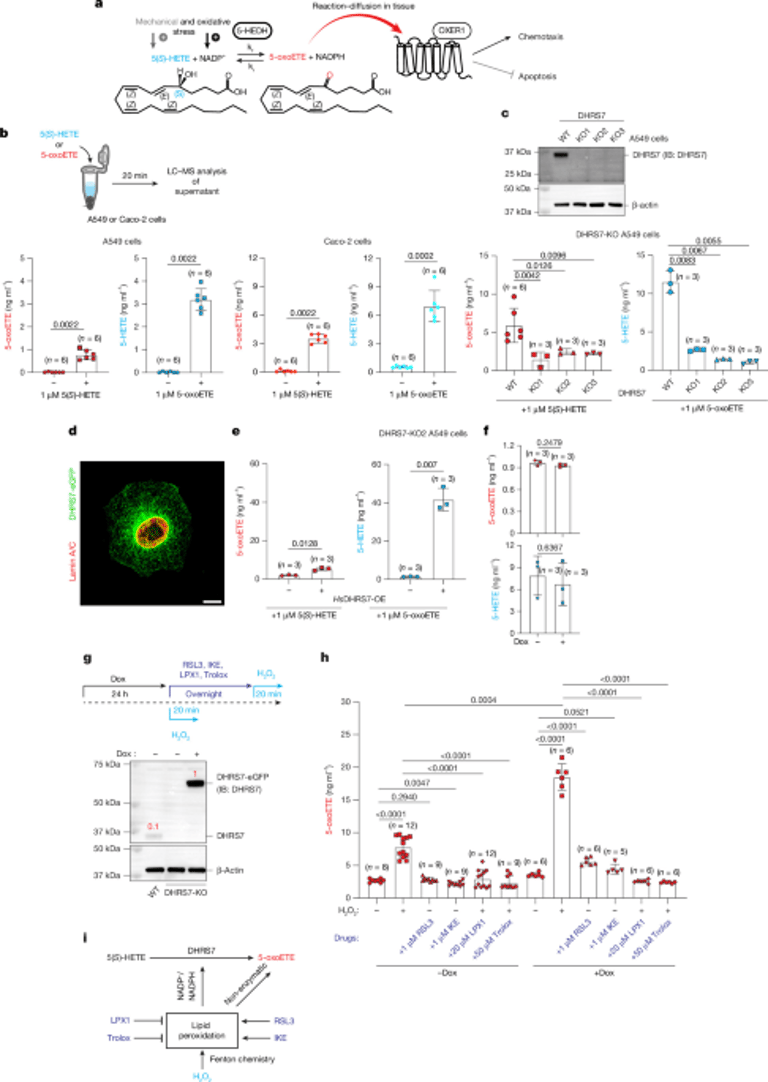

DHRS7 functions as a bidirectional, redox-regulated enzyme that sinks 5-oxoETE under baseline conditions by reducing it to 5-HETE, but shifts to promoting 5-oxoETE production when oxidative stress is present.
DHRS7 is identified as the 5-HEDH enzyme that interconverts 5(S)-HETE and 5-oxoETE in an NADP+/NADPH-dependent manner, placing it at the heart of oxoeicosanoid metabolism.
In zebrafish, DHRS7 is essential for rapid wound detection and leukocyte recruitment; dhrs7 mutants show impaired neutrophil and macrophage chemotaxis to wounds and exhibit altered lipid mediators.
DHRS7 localizes mainly to intracellular membranes, especially the endoplasmic reticulum, and exhibits conserved 5-HEDH activity across species, with human and zebrafish enzymes behaving similarly while rodent variants show weaker activity.
The study links redox biology, lipid signaling via 5-oxoETE, and innate immunity, identifying DHRS7 as a key regulator of oxidative stress–driven epithelial damage detection and resilience.
In the zebrafish gut, loss of DHRS7 leads to increased baseline neutrophil infiltration, suggesting a role in maintaining sterile inflammatory balance that is sensitive to antioxidants.
Site-directed mutagenesis of DHRS7 mapped catalytic residues; mutations like K207E, Y203F, and S190A abolish activity, while others such as N162L and R82E can enhance activity.
In human epithelial cancer cells, DHRS7 knockdown reduces 5-oxoETE and 5-HETE levels, while DHRS7 overexpression increases 5-oxoETE production, confirming its central role in the pathway.
DHRS7-dependent 5-oxoETE signaling operates via the Hcar1-4 receptor pathway in zebrafish, with dhrs7 and hcar1-4 mutations converging on impaired leukocyte recruitment, indicating a shared signaling axis.
Lipid peroxidation and oxidative stress boost DHRS7-mediated 5-oxoETE production, and reactive oxygen species quenchers block this production, linking DHRS7 activity to redox signaling under stress.
Summary based on 1 source
Get a daily email with more Science stories
Source
Nature • Oct 7, 2026
5-oxoETE links redox control of epithelial damage detection and resilience