Mozambique Leads Regional Shift to Integrated Mineral Value Chains, Sustainable Development
December 2, 2025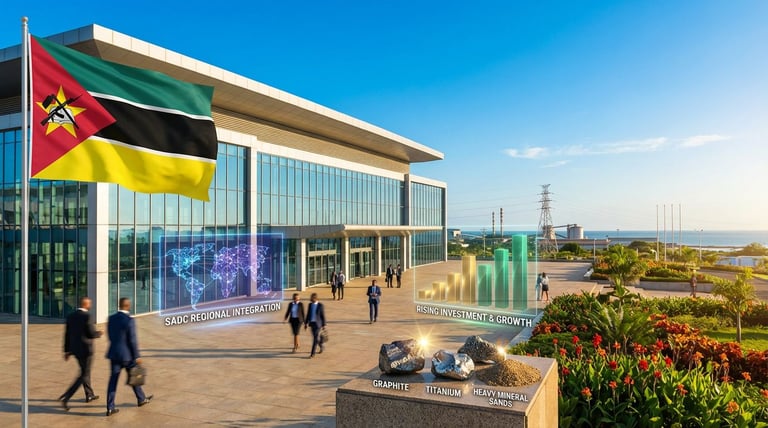

Mozambique is positioned as a regional coordination hub for critical mineral supply chains vital to the energy transition, aiming to shift from enclave models to inclusive, sustainable development across Southern Africa with global implications.
Regional project evaluation will use standardized, performance-based metrics to reduce investor uncertainty and ensure local content, skills transfer, SME impacts, and demographic participation are properly measured as investment criteria.
Northern Mozambique stands out as an energy-mining corridor, with major transmission infrastructure like the METORO-MONTEPUEZ-MARRUPA 220 kV line enabling centralized processing, industrial parks, cross-border power trading, and renewable energy integration.
Implementation is organized around 11 conference panels, supported by working groups, deliverables, template agreements, and standardized MOUs to speed cross-border collaboration and project execution.
Mozambique is shifting from a traditional mineral export model toward an integrated value chain, underpinned by energy infrastructure, security of critical minerals, and regional policy harmonisation to enable domestic processing and stronger regional coordination.
Sustainable development is a competitive differentiator through ESG integration, community development, and green industrial park strategies aimed at carbon-neutral processing and circular economy principles.
Development finance coordination is essential for scaling cross-border projects, with blended finance and multi-lender arrangements proposed to manage multi-jurisdictional risk and create bankable structures.
Policy reform priorities include single-window permitting, SADC-wide standards harmonisation, stronger public-private partnerships for infrastructure, local content with skills development, and coordinated cross-border project processes for better regulatory predictability.
Climate-resilient infrastructure and integrated community development are core to maintain operations, resilience, and a sustained social license to operate.
Cross-border joint ventures, such as MRG Metals-Sinowin and Triton Minerals-Shandong Yulong Graphite, illustrate regional integration with technology transfer, downstream processing, and shared coastal/processing access.
Post-conference actions focus on policy harmonisation, technical standards alignment, streamlined investment facilitation, and coordinated skills development across SADC states to sustain momentum.
Technology transfer and innovation hubs are envisioned around advanced mineral processing, renewable energy integration, environmental monitoring, and digital supply chains to build local capacity and data-driven decision-making.
Summary based on 1 source
Get a daily email with more Macroeconomics stories
Source

Discovery Alert • Dec 1, 2025
MMEC 2026 Mozambique Natural Resources Conference Strategic Transformation