Breakthrough Study Maps Atomic Structure of Key Breast Cancer Transporter, Paving Way for Targeted Drugs
December 5, 2025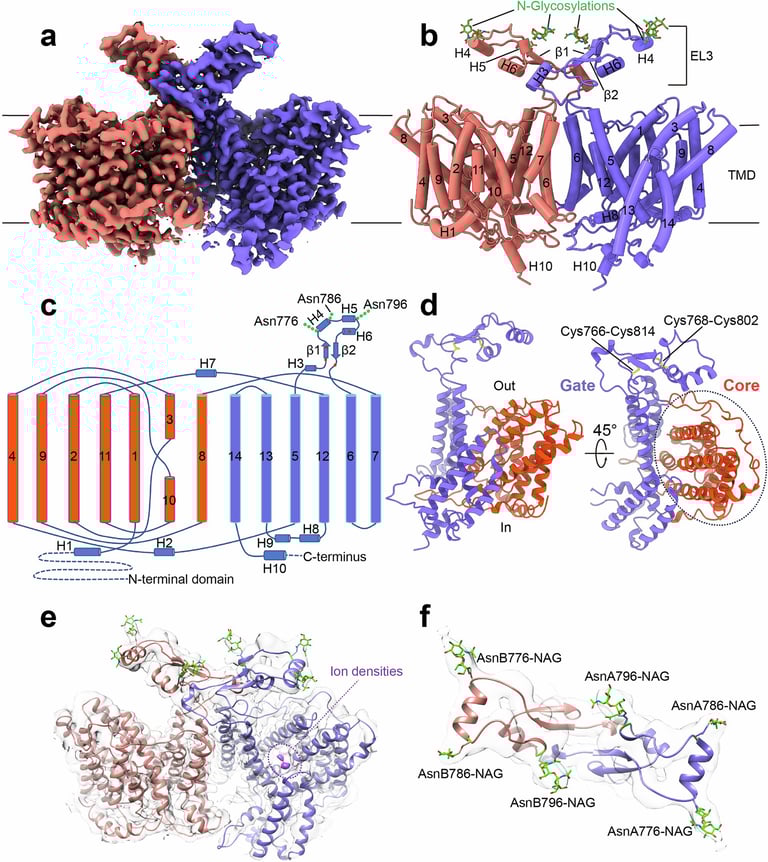

A UCLA-led study maps the atomic-scale structure and function of NBCn1, a plasma membrane transporter that helps breast cancer cells survive acidic, low-oxygen tumor environments by regulating internal pH.
By linking structure, ion energetics, and function, the work provides a blueprint for drugs that could specifically block NBCn1, potentially weakening tumors while sparing normal tissues.
The study combined cryo-electron microscopy to capture the first atomic 3D structure of human NBCn1 with computational modeling to study dynamics and ion pathways.
Funding for the study came from the National Institutes of Health, the Smidt Family Foundation, the Kleeman Fund, and the Factor Family Foundation.
Additional funders include NIH grants, the Smidt Family Foundation, the Kleeman Fund, and the Factor Family Foundation.
The findings were published in Nature Communications, with senior author Dr. Ira Kurtz and collaborators including Weiguang Wang and other UCLA researchers.
The publication is Nature Communications (Wang, W., et al., 2025), with commentary from Dr. Ira Kurtz.
Key personnel include senior author Dr. Ira Kurtz and co-first author Weiguang Wang, along with UCLA contributors Kirill Tsirulnikov, Rustam Azimov, Natalia Abuladze, Liyo Kao, Dora Acuna, Z. Hong Zhou, and Alexander Pushkin.
Using cryo-electron microscopy and computational modeling, researchers reveal NBCn1 operates with an elevator-like mechanism that moves two sodium ions and one carbonate ion per transport cycle, achieving a high rate of about 15,000 ions per second.
Mechanism: NBCn1 employs an elevator-like motion to transport two Na+ ions and one carbonate ion per cycle, enabling roughly 15,000 ions per second while conserving energy.
Overall, the study shows NBCn1 conducts two sodium ions and one carbonate ion via an elevator-like mechanism, supporting a transport rate around 15,000 ions per second and aiding cancer cell survival under stress.
Summary based on 4 sources
Get a daily email with more Science stories
Sources
Medical Xpress • Dec 5, 2025
Structure of protein reveals how breast cancer cells survive in hostile conditions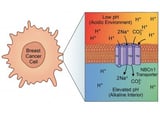
News-Medical • Dec 5, 2025
New atomic structure reveals how NBCn1 transporter protein aids breast cancer cell survival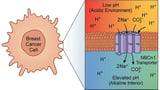
UCLA Health • Dec 4, 2025
UCLA study uncovers how a key protein helps breast cancer cells survive in hostile conditions