Stanford Study Uncovers Secret to Scar-Free Healing: Facial Fibroblasts Hold Key
January 22, 2026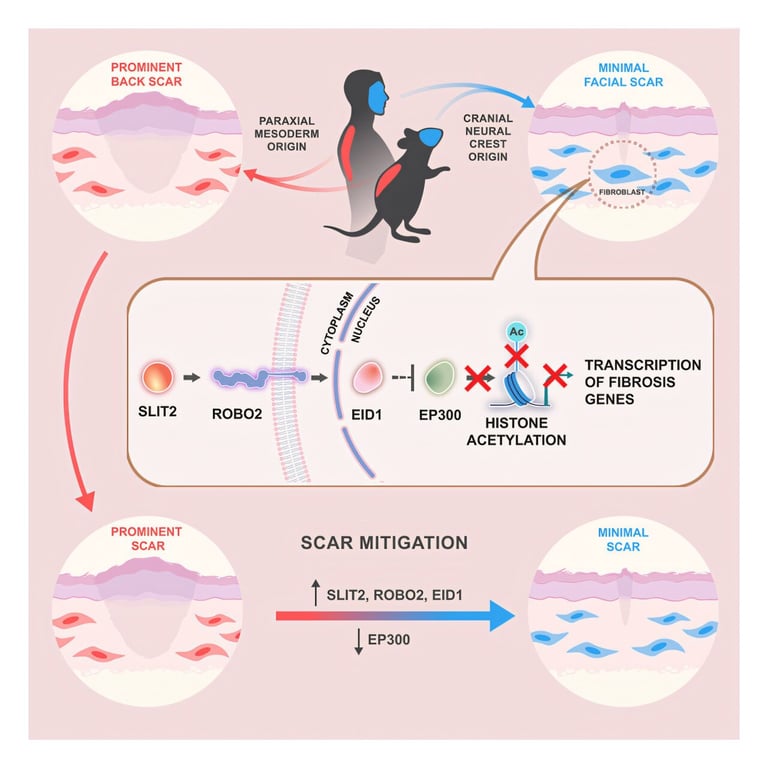

The work was published in the journal Cell on January 22, 2026, and involved contributors from Stanford Medicine and the University of Arizona, among others, with NIH and private foundation funding.
Transplanting facial-derived fibroblasts or injecting genetically altered fibroblasts that resemble facial fibroblasts into non-facial wounds reduces scarring, suggesting that a small number of key cells can trigger broad healing changes.
Experiments show that activating this regenerative pathway in a subset of fibroblasts around abdominal or back wounds leads to significantly less scarring, similar to facial wounds.
Lead authors include Michelle Griffin and Dayan Li, with senior authors Michael Longaker and Derrick Wan from Stanford Medicine.
Longaker and Wan are senior authors, with Dayan Li and Michelle Griffin as lead authors; Longaker holds related patent interests and affiliations with Stanford institutes.
Researchers highlighted that facial wounds’ reduced scarring is linked to evolutionary pressures to preserve facial function—seeing, hearing, breathing, and eating—while healing quickly elsewhere.
The study suggests potential translation to human healing and possibly preventing or treating scars from surgeries or trauma across body sites, with implications for internal scarring as well.
The study suggests the potential to improve wound healing after surgery or trauma by manipulating fibroblast origin or the ROBO2-EP300 signaling axis, with possible relevance to internal scarring beyond the skin.
A Stanford Medicine study in mice identifies why facial and scalp wounds scar less than wounds elsewhere, implicating neural crest–origin fibroblasts and a ROBO2-EP300 signaling pathway in reduced scarring.
Summary based on 2 sources
Get a daily email with more Science stories
Sources
Medical Xpress • Jan 22, 2026
The face scars less than the body: Study explains why
News Center • Jan 22, 2026
The face scars less than the body — a Stanford Medicine study unravels why