Earth's Oceans Hit Record Heat Levels in 2025, Fueling Climate Urgency
January 9, 2026


A sweeping international analysis published in Advances in Atmospheric Sciences confirms that Earth's oceans stored more heat in 2025 than in any year with modern measurements, reaching 23 zettajoules of energy.
The study shows that global ocean heat content (OHC) rose to a new record in 2025, marking the highest level since modern measurements began.
Independent research groups affiliated with the IAP/CAS, the EU Copernicus program, and NOAA compiled data from multiple international centers, with the final results to be featured in a special Advances in Atmospheric Sciences collection on Ocean Heat Content changes.
The collection will examine regional OHC changes and mechanisms, while emphasizing that human decisions on emissions and adaptation will shape future outcomes.
Experts link higher ocean heat to rising surface temperatures, sea-level rise, disrupted marine ecosystems, and more extreme weather, underscoring the urgency of addressing climate change.
The findings draw on datasets from the Chinese Academy of Sciences, Copernicus Marine, NOAA/NCEI, and CIGAR-RT, covering Asia, Europe, and the Americas, and will be compiled into a dedicated Advances in Atmospheric Sciences collection.
Across independent sources, OHC analyses reflect a synthesis of data from international data centers, highlighting a sustained warming trend since the 1990s.
Deep ocean warming results from heat sinking and currents that transport heat to depth, meaning surface warming alone underestimates total ocean warming.
Even with immediate reductions in fossil fuel use, the deep ocean’s stored heat will continue influencing climate for centuries due to slow circulation and deep mixing.
The forthcoming special collection on Ocean Heat Content Changes will include a cover featuring cartoon shrimp and crab inspired by Journey to the West to illustrate vulnerability to warming.
Continued ocean heat accumulation has broad implications for weather, marine life, and global climate systems, reinforcing the impact of anthropogenic warming.
The report places 2025 in the longer trend of ocean warming since the 1990s, noting higher greenhouse gas concentrations and reduced sulfate aerosols contributing to the conditions.
Summary based on 6 sources
Get a daily email with more World News stories
Sources

WIRED • Jan 9, 2026
The Oceans Just Keep Getting Hotter
The Independent • Jan 9, 2026
Results are in for one of the clearest measures of global heating in 2025. It should be raising alarm bells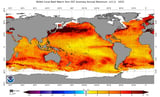
Scientific American • Jan 9, 2026
Ocean Temperatures Just Hit a Dire New Record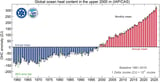
Phys.org • Jan 9, 2026
Ocean temperatures hit another record high in 2025